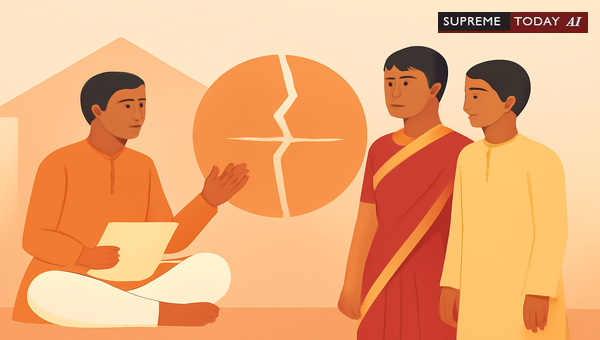
Verbal Partition Among Siblings: Valid Under Indian Law?
In family matters, dividing inherited property can be emotionally charged, especially among siblings. A common question arises: Verbal Partition Among the Siblings are Allowed? Under Indian law, particularly Hindu law governing joint family properties, the answer is generally yes—but with important caveats. This blog post delves into the legal validity of verbal partitions, supported by precedents and practical advice to help families navigate this process smoothly.
Whether you're dealing with ancestral land, a family home, or other joint assets, understanding these rules can prevent costly disputes. We'll cover key principles, court rulings, exceptions, and why documentation matters.
Overview of Verbal Partition in Hindu Law
Hindu law recognizes partitions of joint family property as a way for coparceners (like siblings) to sever their joint status and claim individual shares. Importantly, these partitions don't always need to be formal or written. Verbal agreements among siblings are generally upheld if made with mutual consent and free from coercion2016 0 Supreme(SC) 610.
Courts have long affirmed that family arrangements can be informal. For instance, siblings may agree verbally to an unequal division for valid family reasons, as long as there's no proof of duress 2016 0 Supreme(SC) 610. This flexibility acknowledges the familial context, where written deeds aren't always practical.
Key Legal Principles Supporting Verbal Partitions
1. Mutual Agreement is Paramount
The cornerstone of any verbal partition is mutual consent. Siblings, as co-sharers with equal rights, can divide property orally. Subsequent actions—like exclusive possession of allotted portions—often serve as evidence of the agreement 2022 0 Supreme(Cal) 1336.
Partial partitions are also allowed, where only some properties are divided verbally, while others remain joint 1997 0 Supreme(SC) 1145. This is practical for indivisible assets like a family house.
2. Role of Evidence in Proving Verbal Partitions
While verbal partitions are valid, proving them in court requires evidence. Courts look for:- Long possession: If siblings have acted on the verbal deal for years without objection.- Family conduct: Consistent behavior reflecting the partition.
In one case, claimants failed to prove an oral partition due to lack of evidence, falling back on standard inheritance rights 2025 0 Supreme(Kar) 1582. The court noted: In partition disputes, the burden to prove claims, such as that of a will or oral partition, rests on the claimants. Failure to provide evidence results in favor of standard inheritance rights 2025 0 Supreme(Kar) 1582.
Similarly, without a partition deed, parties remain joint owners, justifying injunctions against alienation 2025 0 Supreme(Telangana) 558. Respondents claiming prior family settlement couldn't produce documents, so the court upheld joint ownership 2025 0 Supreme(Telangana) 558.
Landmark Precedents on Verbal and Oral Partitions
Indian courts have consistently supported informal partitions when consent is clear:- In a High Court ruling, interference with a trial court's findings was noted due to no evidence of coercion in a verbal partition among siblings 2016 0 Supreme(SC) 610.- Under Hindu law, verbal agreements are valid if backed by actions, emphasizing siblings' equal coparcenary rights 2022 0 Supreme(Cal) 1336.
However, challenges arise in disputes:- Oral claims were rejected when unsupported, leading to equal shares for Class-I heirs like daughters 2025 0 Supreme(Kar) 1582.- In another suit, no partition deed meant siblings stayed joint, with injunctions granted to preserve status quo 2025 0 Supreme(Telangana) 558.
These cases highlight: Verbal partitions hold, but evidence is crucial. For example, a sale by one sibling of their verbal share wasn't barred by injunction if it aligned with ownership rights 2024 Supreme(Online)(KER) 31090.
Exceptions and Limitations: When Verbal Partitions Fail
Verbal partitions aren't foolproof:- Coercion or Fraud: If a sibling alleges duress, the partition may be invalidated 2016 0 Supreme(SC) 610.- Lack of Proof: Disputes often hinge on evidence; oral claims alone rarely suffice against written challenges 2025 0 Supreme(Kar) 1582.- Exclusion of Heirs: Partitions ignoring daughters' rights under the Hindu Succession Act (as amended) can be challenged. Ancestral property retains its character post-partition, entitling daughters to equal shares 2024 0 Supreme(Kar) 613. A partition deed excluding married daughters was held non-binding 2024 0 Supreme(Kar) 613.
Additionally, laws like the Maintenance and Welfare of Parents and Senior Citizens Act, 2007, shouldn't be misused for sibling property fights 2016 0 Supreme(Ker) 651.
Practical Recommendations for Siblings
To minimize risks:1. Document the Agreement: Even if verbal, follow up with a simple written memorandum or registered deed. Courts favor this to avoid litigation 2025 0 Supreme(Telangana) 558.2. Seek Witnesses: Family elders or neighbors can corroborate the verbal deal.3. Consult a Lawyer: Get professional advice early, especially for complex assets like agricultural land or unapproved layouts, where registration rules apply 2025 Supreme(Online)(Mad) 66635.4. Register if Possible: For immovable property, registration strengthens enforceability.
In one instance, a partition deed among siblings based on a will was directed for registration after notice to others
Periyadurai Vs The District Registrar (Admin)
.
Conclusion and Key Takeaways
Verbal partitions among siblings are typically allowed under Indian Hindu law, provided there's mutual consent, no coercion, and supporting evidence. Precedents like those in 2016 0 Supreme(SC) 610, 1997 0 Supreme(SC) 1145, and 2022 0 Supreme(Cal) 1336 affirm this flexibility in joint family setups. However, disputes often arise from proof issues, as seen in cases requiring deeds or clear conduct 2025 0 Supreme(Kar) 1582 2025 0 Supreme(Telangana) 558.
Key Takeaways:- Mutual consent makes verbal partitions valid.- Evidence (possession, conduct) is essential.- Document to prevent challenges.- Daughters have equal rights in ancestral property 2024 0 Supreme(Kar) 613.
This post provides general information based on legal precedents and is not specific legal advice. Consult a qualified lawyer for your situation.
References:2016 0 Supreme(SC) 610 1997 0 Supreme(SC) 1145 2022 0 Supreme(Cal) 1336 2025 0 Supreme(Kar) 1582 2025 0 Supreme(Telangana) 558 2024 Supreme(Online)(KER) 31090 2024 0 Supreme(Kar) 613
Periyadurai Vs The District Registrar (Admin)
2025 Supreme(Online)(Mad) 66635 2016 0 Supreme(Ker) 651
#VerbalPartition #HinduLawPartition #FamilyProperty