


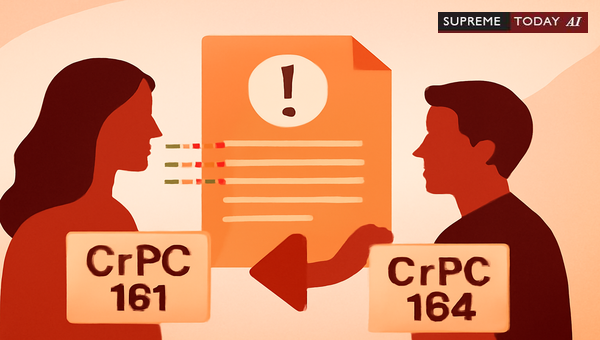
Victim's Conflicting Statements Under 161 & 164: Will Rape Charges Hold?
In high-stakes criminal cases like rape allegations, the statements made by the victim during the investigation phase can raise critical questions. Imagine a scenario where a victim, in her statement under (recorded by police), alleges that the accused committed rape, but in her subsequent statement under (recorded before a Magistrate), she claims the accused did nothing with her. A common query arises: 161 ke byan mein victim kahti hai ki A ne uska rape kiya hai or 164 ke byan mein vahi victim kahti hai ki A ke uske saath kuchh nahi kiya. Us per charge lagega ya nahi?
This discrepancy often puzzles accused persons, lawyers, and even the public. Does such a contradiction automatically lead to dismissal of charges? This blog post delves into the legal nuances, drawing from established precedents and principles under Indian criminal law. Note: This is general information based on legal precedents and not specific legal advice. Consult a qualified lawyer for case-specific guidance.
Understanding Sections 161 and 164 : Nature and Evidentiary Value
Statements under are recorded by police during the investigation. They serve investigative purposes and have limited evidentiary value. As per legal position, Statement recorded under Section 161 of the shall not be used for any purpose except to contradict a witness in the manner prescribed in the proviso to 2010 0 Supreme(SC) 677. These are not proving guilt or innocence but can during trial.
On the other hand, statements are recorded by a Magistrate and carry slightly more weight as they are voluntary declarations under judicial supervision. However, they too are not and can be utilized only to corroborate or contradict a witness vis-a-vis2010 0 Supreme(SC) 677. The has consistently held that neither statement alone determines guilt 2010 0 Supreme(SC) 677.
Key Differences in Purpose
- Section 161: Police inquiry tool, inadmissible as proof except for contradiction (Sections 145/157 ) 2010 0 Supreme(SC) 677.
- Section 164: Judicial record, useful for corroboration but not conclusive 2010 0 Supreme(SC) 677.
Impact of Discrepancies Between Victim's Statements
A flip-flop between Section 161 (alleging rape) and Section 164 (denying any wrongdoing) does not automatically absolve the accused or uphold charges. Courts view such inconsistencies in context:
- Discrepancies are common due to trauma, pressure, or memory lapses and are evaluated during trial alongside all evidence 2017 0 Supreme(Ori) 1460.
- In one case, the court noted the version disclosed in the first information report is so different from the version disclosed in the course of deposition of PW-8 that it cannot be said to be merely clarificatory2017 0 Supreme(Ori) 1460. Yet, it emphasized that statements recorded under Section 161 of the are inadmissible in evidence and its use is limited for the purposes as provided under Sections 145 and 157 of the 2010 0 Supreme(SC) 677.
The trial court assesses the entire body of evidence, including:- Medical/forensic reports.- Other witness testimonies.- Victim's trial deposition.- Circumstantial evidence.
Mere conflicting pre-trial statements rarely decide the case outright.
Real-World Examples from Case Law and Statements
Legal precedents reinforce this. A statement alleging rape shall be sufficient to frame charges under but does not prove guilt at trial 2023 0 Supreme(All) 1139. Charges are framed on basis, but conviction requires .
Additional insights from related cases highlight victim denials:- In scenarios, victims have stated: Main school jati thi per padti nahi thi... Prince ne mere sath koi galat kaam nahi kiya (Prince did no wrong with me)
-
.- Accused statements often show ambiguity: BEHOSH KARNE KE BAAD USKE SAATH BHI SEX KIYA YA NAHI YE MERE KO PURI TARAH SE DHYAN NAHI HAI... MAINE KIYA HI NAHI HAI (Not fully aware if sex occurred after unconsciousness; I did not do it) 2023 Supreme(Online)(All) 27967 2023 Supreme(Online)(All) 25328.These reflect denials under Sections 161/164 and even 14357 , where victims assert maine kiya hi nahi hai (I have not done anything) 2023 Supreme(Online)(ALL) 15982 2023 Supreme(Online)(ALL) 13940. Courts must weigh credibility, as the victim's denial in her and the accused's denial create a conflicting scenario, requiring careful judicial evaluation2023 Supreme(Online)(All) 28576 2023 Supreme(Online)(ALL) 2756.
When Do Discrepancies Matter Most?
While not decisive alone, major inconsistencies can influence outcomes:
Factors Courts Consider
- Consistency Across Statements: If Section 164 aligns with trial testimony, it corroborates 2010 0 Supreme(SC) 677.
- Explanation for Flip: Trauma, coaching, or threats may explain changes.
- Corroborative Evidence: Medical evidence or eyewitnesses often tip the scale 2023 Supreme(Online)(J&K) 467.
- Accused's Defense: Denials like USKE BAAD MAINE JO HAI, KUCHH DIN MAHINA KE KAREEB GHAR GAYA HUA THA... (subsequent activities denying assault) are scrutinized 2023 Supreme(Online)(All) 24518 2023 Supreme(Online)(ALL) 13941.
Exceptions:- Statements cannot be sole proof of guilt.- Discrepancies may lead to acquittal if uncorroborated, but medical evidence prevails.
Trial Process and Recommendations
- Framing Charges: Possible based on Section 164 if it alleges offense 2023 0 Supreme(All) 1139.
- Full Trial: Judge evaluates totality; contradictions used for .
- Best Practices:
- Defense: Highlight discrepancies via cross-exam 2017 0 Supreme(Ori) 1460.
- Prosecution: Rely on corroboration.
- Courts: Evaluate entire evidence, including medical reports, witness credibility2010 0 Supreme(SC) 677.
Conclusion and Key Takeaways
In summary, conflicting victim statements under Sections 161 and 164 —such as alleging rape in one and denial in the other—do not automatically determine if charges will stick. They are tools for contradiction/corrobation, not substantive proof. The trial court's holistic assessment of all evidence decides guilt 2017 0 Supreme(Ori) 1460 2010 0 Supreme(SC) 677.
Key Takeaways:- No Standalone Decision: Discrepancies alone neither convict nor acquit.- Holistic Evaluation: Medical, forensic, and trial testimony crucial.- Precedents Guide: Follow limits on 161/164 use 2023 0 Supreme(All) 1139.- Seek Expert Help: For personalized advice in rape or matters.
This analysis underscores Indian law's emphasis on fair trials. Stay informed, but always consult professionals.
References:1. 2010 0 Supreme(SC) 677: Core on non-substantive nature.2. 2017 0 Supreme(Ori) 1460: Discrepancy evaluation.3. 2023 0 Supreme(All) 1139: Charge framing.4. Other case excerpts as cited.
#CrPC161164, #RapeCaseIndia, #VictimStatement












