


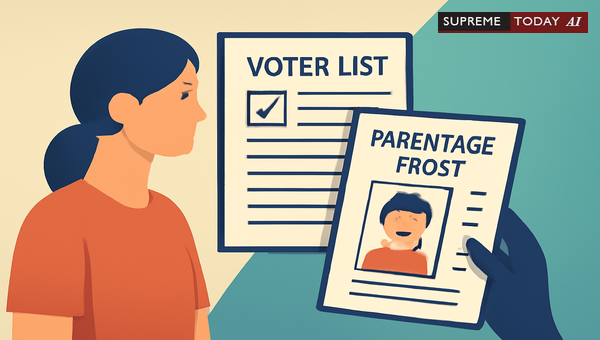
Voter Lists as Proof of Parentage in Civil Suits
In legal disputes involving family relationships, property partitions, or inheritance claims, proving parentage or identity can be pivotal. A common question arises: Can a voter list reflecting the parentage be used as evidence in a civil suit? Voter lists, also known as electoral rolls, often include details like a person's name, parent's name, and address, making them valuable documentary evidence. However, their admissibility, weight, and limitations under Indian law require careful examination.
This article delves into the legal framework, judicial precedents, and practical considerations for using voter lists in civil proceedings. While they are generally admissible, courts emphasize corroboration with other evidence. Note: This is general information based on case laws and statutes; consult a qualified lawyer for advice specific to your case.
Legal Principles Governing Admissibility
Under Indian law, voter lists are public documents and can be , particularly under , which deals with statements in public records made by public servants in the discharge of their duties. These lists are relevant if properly proved and pertinent to the facts in issue, such as establishing parentage, identity, or familial linkages in genealogy or property suits 1999 0 Supreme(Pat) 887.
Courts recognize voter lists as rather than standalone proof. For instance, they help trace relationships across generations, but their entries must be authenticated through or 2001 0 Supreme(HP) 356.
Judicial Precedents on Voter Lists in Civil Suits
Indian courts have consistently relied on voter lists in partition suits, succession claims, and identity disputes. In one notable partition suit, the court used voter lists alongside sale deeds and notices to affirm the plaintiff's parentage, holding them as relevant and admissible evidence for establishing familial links1999 0 Supreme(Pat) 887.
Another precedent clarifies limitations: The voter list showing a person's name in a particular year is not of their being alive or dead but is relevant for establishing identity and linkage2023 0 Supreme(Jhk) 542. This underscores that while useful, voter lists support rather than conclusively determine status.
Public documents like voter lists are admitted unless rebutted by . The absence of weakens the case of the opposing party2001 0 Supreme(HP) 356. In cases involving multiple voter lists from different years (e.g., , , ), courts have pieced them together to build a chain of relationships, as seen in proceedings where exhibits like Ext.B ( voter list) and Ext.C ( voter list) supported claims 2024 0 Supreme(Gau) 448.
Voter Lists in Parentage Verification
Voter lists frequently reflect parentage details, aiding in civil claims. For example, in a case, the voter list showed respondent No. 6's parentage as Tulsi Ram, supporting his sonship claim absent contrary civil rulings 2025 Supreme(Online)(J&K) 743. Similarly, Besides the photo identity card, the voter list is also reflecting that Brahmachari is the father of the plaintiff, bolstering identity findings 2018 0 Supreme(Ori) 751.
Courts have accepted such evidence when corroborated. In a dispute, voter lists from (Exhibit 1) listed family members, though challenged for potential mismatches, they were weighed with other proofs 2024 0 Supreme(Gau) 1317. Another instance involved lists from , , and (Exts. B, C, D) alongside kabinnama and death certificates to establish lineage 2025 0 Supreme(Gau) 880.
Limitations and Challenges
Despite utility, voter lists have constraints:- Not Conclusive Alone: The voter list is not a document which can prove relationship of persons as father and son or grandfather and grandson in the absence of any other document as 2025 0 Supreme(Gau) 552. Mere production of rolls naming a projected father (e.g., Khaimuddin) and grandfather (Innas Ali) fails without backups.- Discrepancies and Gaps: Missing parentage details or absent lists (e.g., post-) undermine claims 2025 0 Supreme(Gau) 872. Inconsistencies, like name variations or unrecorded parentage changes (e.g., from Ishu to Daud), invite rebuttals 2015 0 Supreme(All) 2498.- Possible: Opposing parties can challenge with reliable evidence, such as affidavits or DNA tests 2023 0 Supreme(Jhk) 542. Courts require the relying party to prove via , not solely lists 2018 0 Supreme(Gau) 1047.
Additional proofs like Gaonburah certificates, ration cards, or sale deeds are often mandated 2025 0 Supreme(Gau) 900. In one case, a voter list (Ext.B) was supplemented by a list and Gaonburah certificate 2025 0 Supreme(Gau) 900. DNA testing may be ordered for conclusive parentage 2022 0 Supreme(Gau) 743.
Practical Recommendations for Litigants
To maximize evidentiary value:- Obtain : Secure multiple years' lists showing consistent parentage.- Corroborate Extensively: Pair with birth/death certificates, affidavits, or local authority records 2024 0 Supreme(Gau) 1316.- Anticipate Challenges: Address potential discrepancies early, e.g., explain name changes.- Prove Relevance: Link lists to suit facts, as in partition claims where lists traced tenure holders' heirs 2016 0 Supreme(All) 3543.
In citizenship-linked suits, lacking parentage in lists (e.g., 2025 Supreme(Online)(KER) 5456) can disqualify claims, highlighting verification needs 2025 Supreme(Online)(KER) 5456. Courts favor holistic evidence, accepting lists when no civil contradictions exist 2025 Supreme(Online)(J&K) 743.
Key Takeaways
- Voter lists reflecting parentage are admissible in civil suits under Section 35 of the Evidence Act, aiding identity and linkage proofs 1999 0 Supreme(Pat) 887.
- They excel as corroborative tools in partition, genealogy, and inheritance cases but require supporting evidence 2025 0 Supreme(Gau) 552.
- Rebuttable and Contextual: Weight depends on consistency, rebuttals, and judicial scrutiny 2023 0 Supreme(Jhk) 542.
- Best Practice: Combine with diverse documents for robust cases; seek professional guidance.
Voter lists bridge historical gaps in family proofs but are no silver bullet. Understanding their role empowers better litigation strategies in India's civil courts.
Word count: 1028. References include 1999 0 Supreme(Pat) 887, 2023 0 Supreme(Jhk) 542, 2001 0 Supreme(HP) 356, 2022 0 Supreme(Gau) 743, 2018 0 Supreme(Gau) 1047, 2024 0 Supreme(Gau) 448, TASLEM JAHAN vs State of U.P. AND 3 OTHERS -












