Searching Case Laws & Precedent on Legal Query.....!
Analysing the retrieved Case Laws
Scanned Judgements…!



Searching Case Laws & Precedent on Legal Query.....!
Analysing the retrieved Case Laws
Scanned Judgements…!
Temporary Employees and Pay Parity - Generally, courts have held that temporary or casual employees performing similar duties to regular employees are entitled to wages at least at the minimum of the regular pay scale for their category, but not necessarily to the full regular pay scale with allowances or increments. Several judgments emphasize that such employees are entitled to the minimum of the pay scale but do not automatically qualify for regularization or allowances attached to regular posts ["2024 0 Supreme(AP) 1052"] ["2025 Supreme(Online)(Tel) 71399"] ["2024 0 Supreme(AP) 589"] ["2025 Supreme(Online)(Tel) 57090"] ["2023 0 Supreme(Guj) 468"] ["2024 0 Supreme(Mad) 1421"] ["2023 0 Supreme(AP) 726"] ["2025 0 Supreme(Gau) 861"] ["2025 Supreme(Online)(Mad) 73194"] ["2026 Supreme(Online)(Mad) 1960"] ["2023 0 Supreme(AP) 680"] ["2023 0 Supreme(AP) 203"] ["2025 0 Supreme(AP) 152"] ["2018 0 Supreme(All) 1355"] ["2008 0 Supreme(Raj) 375"] ["P.LAKSHMANAN vs THE STATE OF TAMIL NADU - Madras"] ["2023 0 Supreme(All) 699"] ["2025 Supreme(Online)(Tel) 56077"] ["1999 0 Supreme(J&K) 122"].
Supreme Court and Judicial Principles - The Supreme Court has explicitly stated that temporary employees performing similar duties as regular employees are entitled to wages at the minimum of the regular pay scale for the same post, based on the principle of equal pay for equal work ["2025 Supreme(Online)(Tel) 71399"] ["2025 Supreme(Online)(Tel) 57090"] ["2023 0 Supreme(Guj) 468"] ["2025 Supreme(Online)(Tel) 56077"]. The Court has clarified that such entitlement does not extend to allowances or increments unless explicitly provided ["2024 0 Supreme(AP) 1052"] ["2023 0 Supreme(AP) 680"] ["2023 0 Supreme(AP) 203"].
Regularization and Entitlement Limitations - Continuation as a casual or temporary employee does not confer a right to regularization or higher pay scales. Regularization depends on fulfilling specific criteria, including regular appointment procedures, and is not automatic ["2025 Supreme(Online)(Mad) 73194"] ["2026 Supreme(Online)(Mad) 1960"]. The courts have distinguished between entitlement to minimum pay scales and benefits of regular employment, emphasizing that mere service continuity does not guarantee regular status or associated benefits ["2024 0 Supreme(AP) 589"] ["2018 0 Supreme(All) 1355"].
Specific Case Judgments - Various judgments have reinforced that employees engaged on temporary or contractual basis are entitled only to the minimum of the pay scale applicable to their category, and not to allowances or increments unless explicitly granted ["2025 0 Supreme(Gau) 861"] ["2023 0 Supreme(All) 699"]. The courts have also held that regularization benefits are granted only when procedural and statutory conditions are met ["2025 Supreme(Online)(Mad) 73194"] ["2026 Supreme(Online)(Mad) 1960"].
Analysis and Conclusion:The consolidated legal position indicates that employees engaged on temporary, casual, or contractual basis are generally entitled to wages at the minimum of the regular pay scale for their category, but not to the full pay scale with allowances or increments unless they are officially regularized or specifically granted such benefits. The courts consistently uphold the principle of equal pay for equal work at the minimum pay level but restrict entitlement to regular pay scales, allowances, and increments to regular employees or those who meet regularization criteria ["2024 0 Supreme(AP) 1052"] ["2025 Supreme(Online)(Tel) 71399"] ["2024 0 Supreme(AP) 589"]. Therefore, employees who are not regularized do not have an automatic right to the regular pay scale or its associated benefits.
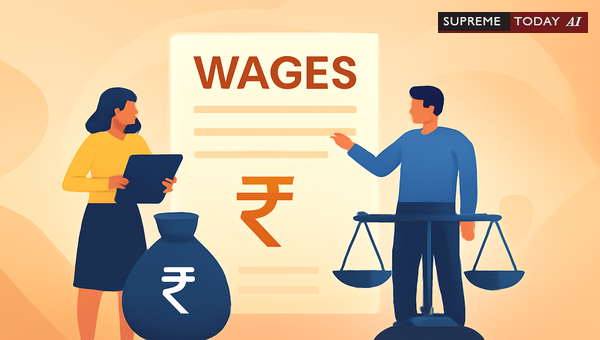
In the realm of Indian labor law, one common grievance among temporary or contract workers revolves around pay structures. Many employees engaged on —a fixed lump-sum payment without increments or allowances—question whether they deserve the same as permanent staff. This issue often arises in government, public sector, and private establishments where or daily wage workers perform duties seemingly identical to regular employees.
The question at the heart of this debate is: employees are not entitled to regular pay scale? While it may seem straightforward, judicial interpretations reveal nuances. This blog post delves into authoritative judgments, key legal principles, exceptions, and practical recommendations, drawing from established case law. Note: This is general information based on precedents and not specific legal advice. Consult a qualified lawyer for your situation.
The Indian judiciary has consistently held that employees on or temporary/ basis are generally not entitled to unless they prove specific criteria. Courts emphasize that applies only when work, responsibilities, and duties are comparable to regular employees, backed by evidence and procedural compliance. Mere nomenclature like consolidated pay or long service does not suffice. 2023 0 Supreme(Gau) 685 2003 4 Supreme 544
As one judgment clarifies: employees engaged on or on a temporary/ basis are generally not entitled to unless they meet specific criteria demonstrating they perform work of a similar nature, responsibilities, and duties as regular employees. 2023 0 Supreme(Gau) 685
Rooted in Articles 14 and 16 of the Indian Constitution, the principle of is a fundamental right. However, it is not automatic for consolidated wage earners. Courts require:
In State of Haryana v. Jasmer Singh (1996) 11 SCC 77, the noted the difficulties in applying the principle mechanically and upheld qualitative differences justifying varied pay. 2000 0 Supreme(Del) 410
To claim , employees must establish:
are tied to specific posts. Those appointed without due process or against unsanctioned posts cannot claim them. Regularization is an administrative policy, not a right. 2003 3 Supreme 215 2002 7 Supreme 518
From additional precedents:- In a university case, contract employees were denied absent proof of discharging the same function as that of the regular Assistant Professors. They received compensation under UGC Regulations instead—emoluments equal to gross salary for three prior years, less amounts paid. 2022 0 Supreme(Ker) 436- However, where proved similar duties, courts granted minimum pay scale from a specific date, rejecting arrears for past service. 2022 0 Supreme(Guj) 670
Courts scrutinize qualitative differences:- Responsibility and skill: Higher in regular roles.- Appointment mode: Consolidated or casual hires lack permanence.- Evidence threshold: Mere long service or employment on a casual or consolidated basis does not automatically confer the right. 2023 0 Supreme(Gau) 685 2002 7 Supreme 518
Claims are often rejected if:- No proof of matching duties. 2003 4 Supreme 544- Valid policy classification exists. 1999 0 Supreme(Del) 1089- Lacks minimum qualifications, as in a daily wage 'mali' (gardener) case where the petitioner failed to show complete and wholesale identity with regular employees. 2005 0 Supreme(All) 1209
In another instance, contract sweepers and fitters in Panchayat Raj were held entitled to minimum pay scale with increments, as they discharged the same duties at par with regulars, per . 2022 0 Supreme(AP) 282
Success is possible if:- Identical duties proven: E.g., petitioners entitled to wages at the minimum of the pay scale (at the lowest grade, in the regular pay scale) for same posts. 2022 0 Supreme(Guj) 670- No procedural barriers: Where selection processes mirrored regulars, though full regularization was not a right. 2017 0 Supreme(Gau) 882
Yet, even here, courts limit benefits: no arrears if delayed claims, or only minimum wages, not full scale. Daily workers may get but not regular scales without post attachment. 2005 0 Supreme(All) 1209
In outsourcing or project-based roles, courts quash arbitrary rejections of if duties match, as in Gujarat contingency workers paid Rs.1350/month. 2022 0 Supreme(Guj) 670
Recommendations:- Employees: Produce concrete evidence of duty identity. 2023 0 Supreme(Gau) 685- Employers: Maintain proper procedures for posts. 2007 2 Supreme 713- All: Approach courts judiciously, respecting administrative policies.
In conclusion, while the principle of equal pay offers hope, judgments affirm that employees are typically not entitled to without meeting stringent tests. This balances worker rights with employer prerogatives. For tailored advice, seek professional legal counsel.
References (select judgments):1. 2023 0 Supreme(Gau) 685 – Fixed pay employees may claim parity if duties match.2. 2003 4 Supreme 544 – Proof of similar work required; no posts means no scale.3. 2000 0 Supreme(Del) 410 – Qualitative evaluation essential.4. 2003 3 Supreme 215 – Due process mandatory.5. 2022 0 Supreme(Ker) 436 – Compensation alternative to parity.
#EqualPayForEqualWork, #LaborLawIndia, #PayScaleRights


He further submits that the petitioners are not entitled for minimum time scale as they are not regular employees. ... Chamoli case19 this Court examined a claim for pay parity raised by temporary employees, for wages equal to those being disbursed to regular employees. ... and in totality of circumstances the petitioners are not entitled to minimum time #HL_STA....

On the first aspect, the Supreme Court in Jagjit Singh’s case (supra) authoritatively settled that temporary employees performing similar duties as those discharged by regular employees are entitled to wages at par with the minimum of the pay-scale of regularly engaged government employees ... (1) SCC 148 pay with meagre wages without being extended the benefit of minimum time scale of ....

Furthermore, it is not the case of the State, that any of the temporary employees would not be entitled to pay parity, on any of the principles summarized by us in paragraph 42 hereinabove. ... There can be no doubt, that the principle of ‘equal pay for equal work’ would be applicable to all the concerned temporary employees, so as to vest in them the right to claim wages, at par with the minimum of the pay-scale o....

This category of temporary employees, was extended the benefit of wages at the minimum of the regular pay- scale. ... The observations of the Apex Court in the judgment (referred to and extracted above), clearly indicates that a temporary employee would be entitled for wages at the minimum pay scale at the lowest grade in the regular pay scale extended to regular#HL_END....

Final directions were issued by the Hon’ble Supreme Court in paragraph 61 of the judgment holding that they had no hesitation that all temporary employees concerned would be entitled to draw wages minimum to the pay-scale at the lowest in the regular pay-scale extended to regular employees holding the ... Devinder Singh, this Court held, that daily- wagers were entitled to be placed in the minimum....

(D) No.34, dated 23.01.2013, orders the Executive Officers of the Town Panchayats to bring 123 panchayat employees, including sanitary workers, into regular time scale of pay from the date of completion of three years of their respective services on consolidated basis, pursuant to orders passed by an ... Thereafter, the services of three sanitary employees, who were similarly placed, were also regularized and brought under regular time scale of #HL_S....
to such employees, they would be entitled to minimum of the regular pay scale which is attached to the post but without any increments. ... pay-scale and not the increments. ... At this stage, reference is made to the aforesaid judgment in the case of Jagjit Singh (supra) for the purpose that even if principle of 'equal pay for equal work' is applicable and the pay in the regular pay#HL_....

He submits that even the temporary employees would be entitled to draw wages at the minimum of pay scale at the lowest grade in the regular pay scale extended to the regular employees holding the same post. ... minimum of pay scale at the lowest grade in regular pay scale extended to the regular emp....

All the judgments noticed in paras 7 to 24 herein above, pertain to employees engaged on regular basis, who were claiming higher wages, under the principle of “equal pay for equal work”. ... For placement in a regular pay scale, the claimant has to be a regular appointee. The claimant should have been selected on the basis of a regular process of recruitment. ... Further, the fact that the petitioners are continuing as casual #HL_ST....

All the judgments noticed in paras 7 to 24 herein above, pertain to employees engaged on regular basis, who were claiming higher wages, under the principle of “equal pay for equal work”. ... For placement in a regular pay scale, the claimant has to be a regular appointee. The claimant should have been selected on the basis of a regular process of recruitment. ... Further, the fact that the petitioners are continuing as casual #HL_ST....

The main argument was that employees appointed on contract basis are not entitled to the pay scale as that of the regular employees. The learned Standing Counsel for the University raised several arguments to assail the said direction.
However, they shall not be entitled to the arrears of salary for the past service. In view of foregoing discussions, all these petitions are allowed. Petitioners shall get the aforementioned pay-scale from 1st of January, 2019. The petitioners are held entitled to the wages at the minimum of the pay scale (at the lowest grade, in the regular pay scale) extended to the regular employees holding the same post.
The ‘temporary employees’ are daily wage employees, adhoc appointees, employees appointed on casual basis, contractual employees and the like. In view of the law aforesaid, the temporary employees are entitled to draw wages on the minimum of pay scale at a lowest grade, in the regular pay scale extended to the regular employees holding the same post.
The petitioners in short are entitled to draw their wages at the minimum of the pay scale at the lowest minimum wage in the regular pay scale extended to regular employees holding similar posts. Considering the decision of the Apex Court in the case of Jagjit Singh (Supra) as well as Peoples Union for Democratic Rights & Ors (supra), I am of the considered opinion that the ratio laid down in the above two cases would cover the case of the petitioners. If the same works out to more than what they are being currently paid the amount which is higher shall be paid to the petiti....

A scale of pay being attached to a definite post, the daily workers are not entitled to claim for equal pay for equal work on parity with the regular employees. However, the daily workers were held entitled to minimum wages (not regular pay scale) as prescribed by the State Government. In the instant case, it is not the case of the petitioner that she is not getting the minimum wage prescribed by the State Government under the Minimum Wages Act. It is for the claimant to establish the complete and wholesale identity between a group of employees claiming identical pay-scales....


An indispensable Tool for Legal Professionals, Endorsed by Various High Court and Judicial Officers
Please visit our Training & Support
Center or Contact Us for assistance

Scan Me!
India’s Legal research and Law Firm App, Download now!


For Daily Legal Updates, Join us on :



 Back to top


