


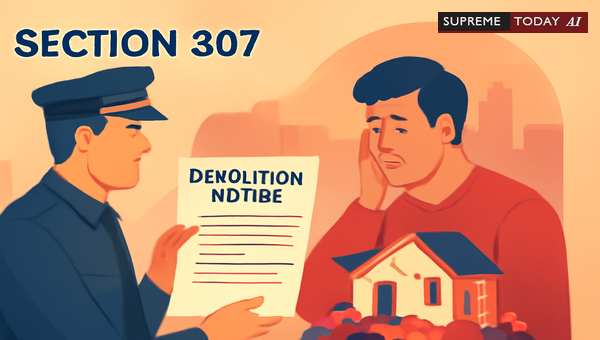
Municipal Demolition Without Hearing: A Violation of ?
Imagine receiving a from your local that's vague, unsigned, or issued without any chance to respond. Suddenly, bulldozers arrive, and your property is razed. Is this legal? The question at the heart of many disputes is: No Option to be Heard: 307 Notice Issued and Demolition Carried out Without Ethical Principles.
In India, such actions by municipal authorities often clash with constitutional safeguards and principles of . Courts have repeatedly ruled that demolitions under Section 307 of the Act—or similar provisions—must follow fair procedures. This blog explores the legal framework, key judgments, and practical insights to help property owners understand their rights.
The Legal Imperative: Specific Notices and Opportunity to be Heard
Notices under Section 307 must be specific, signed by authorized officials, and clearly outline alleged violations2004 0 Supreme(MP) 261. A generic or unsigned notice is invalid, rendering any subsequent demolition illegal. The judgment in 2004 0 Supreme(MP) 261 clarifies that under Section 69(4) or Section 307 of the M.P. Act, the notice must be signed by the Commissioner and specify the exact portion of the building in violation. A generic proforma or unsigned notice is invalid.
More critically, principles of demand a fair opportunity to be heard before demolition 2013 0 Supreme(MP) 420 2006 9 Supreme 95. This means a proper and an effective hearing. Without it, actions violate , which protect equality, freedom, and life/liberty, including property rights.
In 2006 9 Supreme 95, the court observed: no notice under the provisions of Section 351 has been issued by the Municipal Commissioner in this matter, and without issuing a notice under and without giving an opportunity to the appellant of being heard, the structure of the temple could not be ordered to be demolished. This underscores as a constitutional mandate.
Similarly, 2025 3 Supreme 47 directed authorities to provide sufficient notice, allowing occupants time to arrange alternatives. Arbitrary demolitions without hearing are deemed unethical and unconstitutional.
Why Vague Notices and Hasty Demolitions Fail the Ethical Test
Administrative actions affecting property must adhere to transparency, specificity, and ethical standards. In 2013 0 Supreme(MP) 420, the court stressed: before a structure is demolished, every possible effort should be made to effect a proper service of the , and the officer must understand that before a structure is demolished, proper service of the notice is essential.
Failure here makes actions arbitrary. Courts consistently hold that demolitions based on vague or improper notices breach 2025 3 Supreme 47 2006 9 Supreme 95.
Insights from Comparable Cases
Other rulings reinforce this. In 2023 0 Supreme(J&K) 706, a under the was quashed for lacking proper service of a , violating (hear the other side). The court noted no evidence of actual service, entitling petitioners to respond to a valid notice.
Contrastingly, 2023 0 Supreme(Cal) 1489 upheld a demolition under the Act where notice was served via speed post, satisfying statutory requirements. The appellant's failure to collect it didn't invalidate proceedings, showing proper service can fulfill —often through written representations.
In 2023 0 Supreme(P&H) 2729, Haryana demolition orders were quashed for lacking reasoning. Quasi-judicial orders must be with reasons, ensuring transparency and aiding review. Non- infringe rights.
These cases highlight that while may expedite action, procedural safeguards remain essential—even for encroachments 2016 0 Supreme(P&H) 3044.
Exceptions: When Demolitions May Proceed Swiftly
Courts recognize limited exceptions:- threats or unauthorized structures in public spaces may allow faster action, but notices and minimal hearings are still required.- Statutory discretion must follow fairness; deviations invite judicial scrutiny 2016 0 Supreme(Bom) 1852.
For instance, repeated unauthorized construction may limit injunctions 2016 0 Supreme(Bom) 1852, but initial procedural lapses remain fatal.
Practical Recommendations for Property Owners and Authorities
To avoid disputes:- For Authorities: - Issue specific, signed notices stating exact violations. - Serve personally or via reliable methods (e.g., speed post) with reasonable response time. - Conduct hearings and record reasoned decisions.
- For Owners/Occupiers:
- Respond promptly to notices with evidence.
- Challenge vague or unsigned notices in court immediately.
- Seek if demolition looms.
Demolitions ignoring these are challengeable as illegal 2013 0 Supreme(MP) 420.
Key Takeaways from Judicial Precedents
| Case ID | Core Holding ||---------|--------------|| 2004 0 Supreme(MP) 261 | Notices must be signed/specific; generic ones void. || 2013 0 Supreme(MP) 420 | Proper service and hearing essential pre-demolition. || 2006 9 Supreme 95 | No notice/hearing breaches constitutional rights. || 2025 3 Supreme 47 | Sufficient notice for arrangements required. || 2023 0 Supreme(J&K) 706 | Lack of show-cause voids notice. |
Conclusion: Upholding Ethical Principles in Municipal Actions
Issuing Section 307 notices and executing demolitions without a hearing or based on vague formats is typically arbitrary, unethical, and contrary to law. Property rights deserve due process. While this overview draws from established rulings, outcomes depend on specifics—consult a legal expert for advice tailored to your situation.
This is general information, not legal advice. Laws vary by jurisdiction.
#MunicipalDemolition, #NaturalJustice, #PropertyRights












