




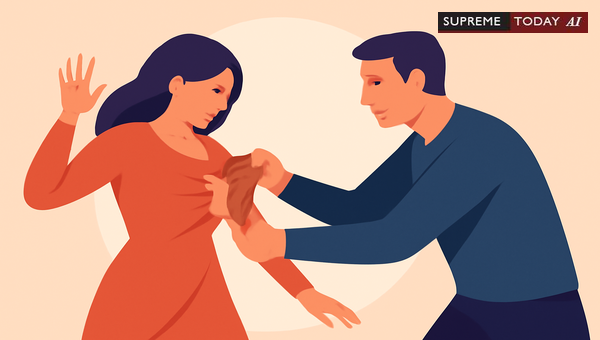
Section 354 IPC: Tearing Clothes Without Hurt – No Conviction?
In the realm of criminal law in India, addresses the serious offence of to a woman with intent to . But what happens when an accused is charged under this section for merely tearing a woman's clothes, without causing any injury or hurt? Does such an act automatically constitute outraging modesty? This is a common query in legal circles: leading case law on section 354 when tearing of cloth while hurt not lead to conviction under section 354.
This blog post delves into the nuances of Section 354 IPC, analyzing key judicial precedents, essential ingredients of the offence, and factors that courts consider. While this provides general insights based on established case law, it is not legal advice—consult a qualified lawyer for specific cases.
Understanding Section 354 IPC: The Core Elements
Section 354 IPC punishes whoever assaults or uses criminal force to any woman, intending to outrage or knowing it to be likely that he will thereby . The punishment can extend to two years imprisonment and/or fine.
The essential ingredient is that the act must be capable of of a woman2021 0 Supreme(Jhk) 1002. Courts have repeatedly emphasized that the essence of a woman's modesty lies in her sex, and the of the accused is crucial 2021 0 Supreme(Jhk) 1002. Mere physical contact or trivial acts do not suffice; the act must, in the given circumstances, outrage modesty.
Key points from judicial interpretations:- The act must involve with the specific intent to outrage modesty.- Context matters: Location, manner of the act, and the woman's reaction are pivotal.- Not every act of tearing clothes qualifies—especially without injury or a shocking element 1997 8 Supreme 129.
The Critical Question: Tearing Clothes Without Hurt or Injury
A frequent scenario in Section 354 cases involves allegations of tearing the victim's clothes (e.g., blouse or saree) during a scuffle. Prosecutors often argue this alone outrages modesty, but courts scrutinize deeper.
When Tearing Clothes Does NOT Lead to Conviction
In 1997 8 Supreme 129, the court held that tearing clothes alone, without resulting in injury or hurt, and absent evidence that the act shocked decency, does not sustain a conviction under Section 354. The judgment clarified: tearing clothes alone might not suffice unless the act was of such a nature that it could be described as capable of shocking decency1997 8 Supreme 129.
This aligns with broader principles where minimal or accidental tearing, without a 'sex angle' or intent to outrage, fails the test. For instance, in domestic disputes or altercations without explicit modesty outrage, courts acquit if the act appears incidental
. Here, pulling or disturbing clothes was alleged, but lacked sufficient proof of intent, leading to setting aside the conviction under Section 354.
When Conviction is Upheld Despite No Injury
Conversely, not all cases without injury result in acquittal. In 2006 7 Supreme 741, the court upheld conviction where the accused tore the prosecutrix's blouse. The evidence was reliable, and the act was deemed capable of shocking decency2006 7 Supreme 741. The court noted: the act of tearing the blouse, which was capable of shocking decency, was sufficient to constitute an offence under Section 354, even if no injury or hurt was caused2006 7 Supreme 741.
Similarly, in
, arguments centered on tearing the blouse leading to outraging modesty, though the defense contested lack of attempt to outrage. Courts infer intent from actions like apprehension followed by tearing, especially with consistent victim testimony.
Another example: In a case involving assault over a dispute, conviction under Sections 323 (hurt) and 354 was upheld based on tearing clothing and inferred intent 2012 0 Supreme(Ker) 724. The was: the intention to outrage modesty can be inferred from the actions of the assailant, particularly in the context of physical assault and the tearing of clothing2012 0 Supreme(Ker) 724. Sentence was reduced considering trial delays, but the Section 354 conviction stood.
Judicial Tests and Factors Courts Consider
Courts apply a multi-factor test:- Nature of the act: Was the tearing forcible and exposing? Or minimal/disturbed casually?
GIGI vs STATE OF KREALA Advocate - - 2012 Supreme(Online)(KER) 37053
- Victim's reaction: Outcry, resistance, or shock indicates outrage 2006 7 Supreme 741.- Context and intent: Isolated scuffle vs. sexually motivated? Intention to outrage modesty can be inferred from the perpetrator's actions and the context of the assault (from case summary on assault under ).- Corroboration: Eyewitnesses, medical evidence, or chemical analysis (e.g., semen on clothes in rape-linked cases) 2013 0 Supreme(Bom) 2285.In
, absence of witness testimony on tearing led to scrutiny, reinforcing that uncorroborated claims weaken Section 354 cases.
Exceptions and Limitations:- Accompanied by hurt/assault: Easier conviction, e.g., under Sections 323/354 together 2019 0 Supreme(Raj) 2872.- Trivial/accidental acts: No outrage if no shock to decency 1997 8 Supreme 129.- avoidance: Cannot convict under both 354 and 376 for same act; 354 is lesser 2013 0 Supreme(Bom) 2285.
Broader Implications and Evolving Jurisprudence
Recent trends emphasize victim-centric approaches but demand proof of intent. In revision petitions, prolonged trials lead to sentence reductions while upholding convictions if evidence holds 2019 0 Supreme(Raj) 2872. Courts remind that neither the use of criminal force alone nor act of outraging the modesty alone is sufficient to attract an offence under S.354 IPC
GIGI vs STATE OF KREALA Advocate - - 2012 Supreme(Online)(KER) 37053
.Note unrelated contexts like (judgment contents) 2016 0 Supreme(Kar) 589 or personal laws ( on custody) 2016 0 Supreme(Bom) 1064, which do not apply here.
Recommendations for Legal Practitioners and Victims
- For defense: Highlight lack of injury, context, and no shock to decency; cite 1997 8 Supreme 129.
- For prosecution: Prove intent via circumstances, victim reaction; rely on 2006 7 Supreme 741.
- Courts: Examine holistically—Courts should examine the circumstances, including the manner of tearing, the reaction of the victim, and whether the act was of such a nature as to shock decency.
Key Takeaways
- Tearing clothes without hurt/injury generally does not lead to Section 354 conviction unless capable of shocking decency1997 8 Supreme 129 2006 7 Supreme 741.
- Intent and context are decisive; infer from actions 2012 0 Supreme(Ker) 724.
- Always consider victim's reaction and corroboration.
In conclusion, while tearing clothes can support a Section 354 charge, it is not automatic sans injury or outrage element. Leading cases like 1997 8 Supreme 129 and 2006 7 Supreme 741 guide that the act must truly shock a woman's sense of decency, viewed through circumstances. This balances protecting women with ensuring fair trials. For personalized guidance, seek professional legal counsel.
#Section354IPC, #OutragingModesty, #IPCCaseLaw












