SupremeToday Landscape Ad
AI Thinking

AI Thinking...

Searching Case Laws & Precedent on Legal Query.....!

Scanned Judgements…!

Checking relevance for Hira Lal VS State (Govt. of NCT) Delhi...

2003 5 Supreme 112 : The conviction under Section 306 IPC was upheld in the case, as there was sufficient material to convict the appellants under Section 306 IPC despite no charge being framed for it. The court noted that while the conviction under Section 304B IPC could not be sustained due to lack of proof of cruelty or harassment ''''soon before'''' death, the evidence supported a conviction under Section 306 IPC. The sentence of three years'''' imprisonment under Section 306 IPC was deemed sufficient to meet the ends of justice and was maintained.Checking relevance for Shaik Nagoor VS State of A. P. rep. by its Public Prosecutor, High Court of A. P. , Hyderabad...

2008 0 Supreme(SC) 294 : The appeal against conviction for the offence under Section 306 of the Indian Penal Code was dismissed by the Andhra Pradesh High Court. The High Court upheld the conviction under Section 306 IPC, despite setting aside the conviction for other offences. The judgment confirms that the conviction under Section 306 IPC was maintained, and the appeal against it was dismissed.Checking relevance for Kisan @ Pilaji Gangaram Khatale VS State of Maharashtra...

Checking relevance for LOKENDRA SINGH VS STATE OF M. P. ...

Checking relevance for M. Vijayakumar VS State of Tamil Nadu...

2024 3 Supreme 293 : The conviction under Section 306 of the Indian Penal Code, 1860 (abetment of suicide) was confirmed by the High Court and upheld in the appeal. The appellant was convicted for the offence under Section 306 IPC, and although the sentence was reduced from seven years to three years rigorous imprisonment, the conviction itself was not overturned. The court held that the prosecution had established the necessary mens rea and abetment, and despite issues with the application of Section 106 of the Evidence Act, the conviction under Section 306 IPC was sustained.Checking relevance for Randhir Singh VS State Of Punjab...

2004 7 Supreme 420 : The conviction under Section 306 IPC (abetment to suicide) was upheld by the High Court and subsequently affirmed by the Supreme Court in the impugned judgment. The case involved the suicide of the wife of appellant No.1, which occurred within seven years of marriage, and the trial court found evidence of dowry demands and harassment by the appellants. The High Court and Supreme Court both upheld the conviction, finding that the evidence of the deceased''''s parents regarding dowry demands and the circumstances surrounding the suicide supported the finding of abetment under Section 306 read with Section 34 IPC. The Court emphasized that abetment requires a mental process of instigating or intentionally aiding the commission of suicide, and that the courts must carefully assess facts and circumstances to determine if cruelty induced the victim to commit suicide. The conviction was not interfered with due to the absence of infirmity in the trial and appellate courts'''' reasoning.Checking relevance for Randhir Singh VS State Of Punjab...

2004 7 Supreme 420 : The conviction under Section 306 of the Indian Penal Code (abetment of suicide) was upheld by the High Court, despite a reduction in the custodial sentence to three years. The court affirmed that even if the deceased did not explicitly prove the demand of dowry before certain persons, the evidence regarding such demand was still cogent and reliable when established by other credible means. The conviction was maintained due to sufficient and reliable evidence supporting the charge under Section 306 read with Section 34 IPC.


AI Overview

AI Overview...

  • Section 325 IPC - Convictions and Sentences
  • Main points:

  • Analysis and Conclusion:

  • Section 325 IPC prescribes both imprisonment and fine, with the default being imprisonment till the court's rising plus a fine. Courts have the discretion to modify jail terms, often reducing them to the period already served, and to enhance fines to serve justice or compensate victims.
  • The courts consider factors such as injury severity, age of accused, and case specifics when sentencing or modifying sentences.
  • Fines are frequently increased to higher amounts (up to Rs. 15,000 or more), and default imprisonment for non-payment is imposed if fines are not paid within stipulated periods.
  • Overall, the legal trend emphasizes the dual nature of Section 325 IPC (imprisonment and fine) and the courts' authority to tailor sentences based on case facts, with TRC being a common component unless waived.

References:- 2023 Supreme(Online)(MP) 23608- 2024 Supreme(Online)(MP) 2797- 2024 0 Supreme(Jhk) 51- 2023 0 Supreme(Pat) 100- 2024 0 Supreme(MP) 187- 2023 0 Supreme(MP) 53- 2022 0 Supreme(Raj) 1186- 2024 0 Supreme(MP) 707- 2023 0 Supreme(All) 1975

Sentencing Under Section 325 IPC: Mandatory Imprisonment and Liability for Fines

Section 325 IPC: Conviction and Fine Explained

Introduction

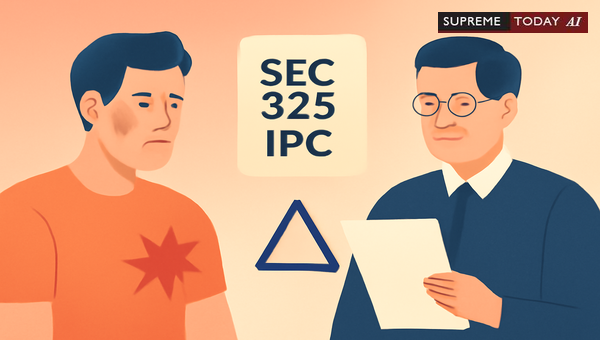
Assault cases involving serious injuries often lead to charges under the Indian Penal Code (IPC), particularly Section 325, which deals with voluntarily causing grievous hurt. A common question arises in such matters: Can Section 325 IPC convict TRC and fine? In simpler terms, can a court convict an accused under Section 325 IPC and impose both imprisonment and a fine as punishment?

This blog post dives deep into the legal framework, statutory language, and judicial interpretations to provide clarity. While this information is for educational purposes and draws from established precedents, it is not a substitute for professional legal advice. Always consult a qualified lawyer for case-specific guidance.

What is Section 325 IPC?

Section 325 IPC addresses the offense of voluntarily causing grievous hurt, excluding cases covered under Section 335 (which involves hurt caused on grave and sudden provocation). Grievous hurt includes fractures, dislocations, or injuries that endanger life or cause severe pain for 20 days.

The punishment prescribed is imprisonment of either description for up to seven years, and also a fine. The explicit wording—shall be punished with imprisonment... and shall also be liable to fine—indicates that both penalties can be imposed concurrently. Courts typically have discretion in determining the sentence based on the case's facts, injury severity, and offender's background.

Legal Provisions: Imprisonment and Fine Under Section 325

The statutory text is clear:

Whoever, except in the case provided for by section 335, voluntarily causes grievous hurt, shall be punished with imprisonment of either description for a term which may extend to seven years, and shall also be liable to fine.

This language confirms that fines are not optional but a standard component. Courts routinely impose both, often adjusting the fine amount to meet justice's ends. For instance, fines can be enhanced on appeal to compensate victims or reflect case gravity.

Key points from the provision:- Imprisonment: Mandatory, up to 7 years (simple or rigorous).- Fine: Liable in addition, amount at court's discretion.- No minimum sentence specified, allowing flexibility.

Judicial Precedents: Conviction with Fine is Standard

Indian courts, including the Supreme Court and High Courts, have consistently upheld that convictions under Section 325 IPC can—and often do—include fines alongside imprisonment. Here are pivotal cases:

In State of Uttar Pradesh v. Tribhuwan & Ors.2011 0 Supreme(All) 1571, the Supreme Court ruled that the maximum punishment includes both imprisonment and fine. The High Court had erred by setting aside jail terms and imposing only fines, exceeding its jurisdiction. The Court stressed:

Jail sentence is mandatory u/s 325 IPC. 2017 0 Supreme(SC) 1062

This reinforces that while fines are integral, imprisonment cannot be wholly substituted.

Another ruling by Bibek Chaudhuri, J. 2018 0 Supreme(Raj) 1303 notes courts' authority to impose fines with imprisonment under Section 325.

Appellate courts frequently modify sentences while retaining fines. For example:- Fine enhanced from Rs.1,000 to Rs.15,000 each under Section 325, with jail reduced to period undergone 2023 0 Supreme(MP) 207.- Accused sentenced to 1 year RI with fine of Rs.400 under Section 325 2021 0 Supreme(MP) 271.- Fine under Section 307 treated as fine under Section 325, remaining intact 2019 0 Supreme(Chh) 266.- Conviction upheld with 1 year 5 months RI, fine unaltered 2010 0 Supreme(P&H) 3131.

These precedents show courts' discretion to enhance fines for victim compensation under CrPC Section 357, even while reducing jail terms due to delays or other factors.

Real-World Applications and Sentencing Practices

In practice, sentencing varies:

Routine Imposition of Both Penalties

  • Chief Judicial Magistrate Sonepat case2011 0 Supreme(P&H) 84: Petitioner convicted under Sections 325/323/148 IPC, sentenced to 1 year RI and Rs.2,000 fine under 325.
  • Courts often direct concurrent sentences and treat prior fines as applicable under Section 325.

Probation and Alternatives

  • Probation of Offenders Act, 1958, applied in some cases, maintaining conviction but releasing on probation with enhanced fine and warnings 2011 0 Supreme(P&H) 84.

Conversion from Graver Charges

Remand for Evidence

  • Even in appeals, courts remand for witness examination (e.g., doctor for X-ray) to prove grievous hurt under Section 325 2021 0 Supreme(MP) 271.

Exceptions and Limitations

While fines are standard, rare scenarios may limit them:- If facts don't warrant a fine (e.g., extreme leniency), courts might impose only imprisonment—though uncommon for Section 325.- High Courts may reduce sentences considering litigation delays (e.g., 37 years), modifying jail to period undergone but retaining/enhancing fines 2017 0 Supreme(SC) 1062.- Statutory restrictions or specific case laws could apply, but none broadly prohibit fines here.

Key Takeaways for Legal Practitioners and Accused

  • Courts can convict under Section 325 IPC and impose fines: Supported by statute and precedents.
  • Discretion in sentencing: Fines often enhanced for justice; argue based on injury nature and precedents.
  • Victim compensation: Fines payable to complainants under CrPC 357.
  • Appeals: Focus on mandatory jail while fines provide flexibility.

Legal practitioners should cite explicit statutory language and cases like 2011 0 Supreme(All) 1571 2018 0 Supreme(Raj) 1303 2020 0 Supreme(Jhk) 1035 to advocate appropriately.

Conclusion

Yes, under Section 325 IPC, courts generally convict and impose both imprisonment and fine. This dual punishment aligns with legislative intent for grievous hurt offenses, balancing retribution and deterrence. Judicial trends favor fines for compensation, with modifications on appeal.

Stay informed on evolving case law, as sentencing reflects case-specific justice. For personalized advice, reach out to a legal expert.

This post is for informational purposes only and does not constitute legal advice.

#Section325IPC #GrievousHurt #IPCLaw
Chat Download
Chat Print
Chat R ALL
Landmark
Strategy
Argument
Risk
Chat Voice Bottom Icon
Chat Sent Bottom Icon
SupremeToday Portrait Ad
logo-black

An indispensable Tool for Legal Professionals, Endorsed by Various High Court and Judicial Officers

Please visit our Training & Support
Center or Contact Us for assistance

qr

Scan Me!

India’s Legal research and Law Firm App, Download now!

For Daily Legal Updates, Join us on :

whatsapp-icon Back to top