
 Back
Back





IN THE HIGH COURT OF JUDICATURE AT ALLAHABAD
VIPIN CHANDRA DIXIT, SHEKHAR B. SARAF, JJ.
Agmotex Fabrics Private Limited – Appellant
Versus
State Of Uttar Pradesh And Others – Respondents
Writ Tax No.1757 of 2024
Decided on : 18-11-2024
(A) Goods and Services Tax Act, 2017 - Section 74 - Principles of natural justice - Writ petition challenging the order imposing tax liability and penalty - The impugned order was found to be arbitrary as it merely copied the petitioner's reply without proper consideration and failed to provide necessary documents or a fair hearing - The court emphasized the necessity of examining the fabrics and granting a reasonable opportunity to the petitioner to present its case. (Paras 19, 20, 21)
(B) Natural Justice - The principles of natural justice require that no one should be condemned unheard and that the affected party must be given a reasonable opportunity to present its case - The court reiterated that the failure to provide necessary documents and a fair hearing constitutes a violation of these principles. (Paras 8, 10, 12)
JUDGMENT :
(Judgement dictated in open Court by Shekhar B. Saraf, J.)
1. Heard learned counsel for the parties and perused the record.
2. This writ petition has been filed under Article 226 of the Constitution of India, wherein the writ petitioner is aggrieved by the impugned order dated September 12, 2024 passed by the Deputy Commissioner, State Goods & Services Tax, Sector 17, Kanpur/respondent No.3 under Section 74 of the Goods and Services Tax Act, 2017 (hereinafter referred as 'the Act') for the financial year 2021-22.
3. Factual matrix giving rise to the instant writ petition is delineated below:
a. On December 27, 2022, petitioner’s Business premises were subjected to a search where it was found that the petitioner had wrongly availed the Input Tax Credit ( hereinafter referred to as “ITC”) and refund of the same on purchase of glycerin, fatty acid and finishing chemical made up of perfumery compound. It was further found that the petitioner had also not produced proper evidence with regard to cancelling 115 e-way bills by it during the financial year 2021-22. Subsequently, a show cause notice dated March 20, 2024 was issued to the petitioner by the Deputy Commissioner, State Goods and Services Tax Sector-17, Kanpur/respondent No.3 asking it to refund the excess utilization of ITC along with penalty amounting to Rs. 2,24,24,710/- by April 19, 2024.
b. In response to the aforesaid show cause notice, the petitioner filed its reply on April 18, 2024 wherein it denied the allegations made against it mentioning that the show cause notice was not supported with any evidence or material.
c. On June 4, 2024, another show cause notice under Section 74 of the Act was issued to the petitioner by which the amount of Tax and penalty was revised to Rs. 2,43,74,686/-.
d. In response to the notice dated June 4, 2024, the petitioner again filed its reply supported with an affidavit wherein it again denied the allegation that the glycerin, fatty acid and perfumery compound are not used in its business and submitted that these materials are used as ‘raw material’ by the company in manufacturing process and the ITC with respect to these materials has been legally availed by the petitioner. Explanation in respect of 115 e-way bills that were cancelled during the financial year 2021-22 was also furnished by the petitioner in his affidavit.
e. In spite of the reply dated July 2, 2024 having been uploaded by the petitioner on the portal, the respondent no. 3 gave a reminder dated August 8, 2024 to the petitioner and asked it to appear for personal hearing and submit its reply by September 6, 2024.
f. The petitioner vide its letter dated August 10, 2024, informed the respondent no. 3 that it has already given a detailed reply dated July 2, 2024 in response to the show cause notice.
g. Notwithstanding reply submitted by the petitioner, the respondent No. 3 passed the order dated September 12, 2024 under Section 74 of the Act imposing a demand of Tax along with penalty and interest amounting to Rs. 37,31,642/- upon the petitioner. Relevant portion of the said order reads as under:
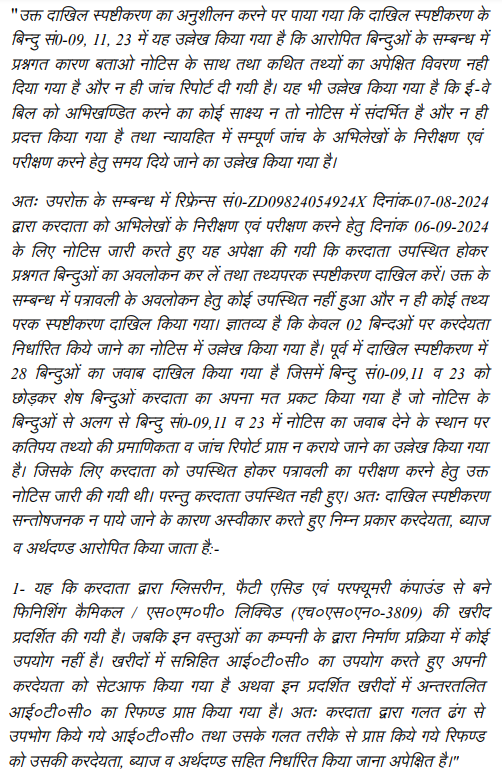
(Below is the English translation of the above Hindi portion)
On perusal of the said filed explanation, it is found that in the point Nos.9, 11 & 23 of the filed explanation, it has been mentioned that the desired details of the so called facts have not been given with respect to the Show Cause Notice regarding the charges, nor has been the inquiry report provided. It has also been mentioned that neither there is any reference of any evidence in the notice regarding the quashing of the e- way bill nor has it been provided and it is mentioned to provide time, in the interest of justice, for inspection and examination of records of the entire inquiry.
Therefore, in relation to the above, by issuing notice to the taxpayer for inspection and examination of the records on 06-09-2024 by reference No.ZD090824054924X dated 07-08-2024, it was expected that the taxpayer should appear and obser
AI
The principles of natural justice mandate that an affected party must be given a fair opportunity to present its case, and failure to do so renders the decision arbitrary and illegal.

The main legal point established in the judgment is the significance of the principles of natural justice, particularly audi alteram partem, in ensuring a fair and reasonable opportunity of hearing b....

Natural justice principles require a fair hearing before any order with civil consequences is made, as established in several Supreme Court decisions.

The right to cross-examine in tax proceedings is context-dependent, and denial does not constitute a breach of natural justice if sufficient opportunity to contest the findings is provided.

The failure to provide valid notice and opportunity to be heard constitutes a violation of natural justice, necessitating quashing of ex parte orders under the GST Act.

Natural justice is context-dependent; its violation must demonstrate actual prejudice to affect the legality of administrative actions like environmental compensation assessment.
Natural justice is flexible, requiring context-specific application, with emphasis on actual prejudice caused to uphold procedural fairness in administrative decisions.



An indispensable Tool for Legal Professionals, Endorsed by Various High Court and Judicial Officers
Please visit our Training & Support
Center or Contact Us for assistance

Scan Me!
India’s Legal research and Law Firm App, Download now!


For Daily Legal Updates, Join us on :



 Back to top


