Searching Case Laws & Precedent on Legal Query..!
Scanned Judgements…!



Searching Case Laws & Precedent on Legal Query..!
Scanned Judgements…!
Denial of Backwages Due to Lack of Evidence of Gainful Employment - Courts generally require employers to lead cogent evidence proving that the employee was gainfully employed elsewhere to deny backwages after illegal termination. If such evidence is not provided, courts tend to favor granting full backwages, especially when the employee remains unemployed post-termination. For instance, The respondent/Corporation contended that the petitioner was not entitled for back wages since the petitioner had neither pleaded nor provided any material evidence regarding the employment status ["2025 Supreme(Online)(Mad) 73872"]. Similarly, The Court is of the view that denial of backwages for the Lay-off period on the premise that there is no pleading and evidence for not being gainfully employed elsewhere is erroneous ["2025 0 Supreme(Kar) 2486"].
Legal Presumption of Unemployment Post-Illegal Termination - When an employee is unlawfully terminated, courts often presume the employee to be unemployed unless the employer proves gainful employment during the period. The very idea of restoring an employee to the position which he held before dismissal... implies that the employee will be put in the same position in which he would have been but for the illegal action ["2022 0 Supreme(SC) 971"]. If the employee remains unemployed and no evidence of employment is produced, courts typically award full backwages, emphasizing that denial of back wages would amount to indirectly punishing the employee concerned Deepali Gundu Surwase v. APSRTC.
Burden of Proof on Employer to Demonstrate Gainful Employment - Employers must substantiate claims that the employee was employed elsewhere and earning wages comparable to prior employment to deny backwages. If the employer wants to avoid payment of full back wages, then it has to plead and also lead cogent evidence to prove that the employee/workman was gainfully employed and was getting wages equal to the wages he/she was drawing prior to the termination ["2023 0 Supreme(Raj) 1315"]. Failure to do so results in courts favoring the employee's entitlement to full backwages.
Reinstatement and Backwages - Reinstatement is generally the default remedy for illegal termination. However, courts may deny full backwages if the employee was employed elsewhere or if reinstatement is deemed inappropriate due to deteriorated employer-employee relations. Considering the factual matrix of this case... reinstatement of the Claimant to his former position in the Company not ["a"] suitable remedy ["
ANG CHIN GAIK vs WV SERVICES MALAYSIA SDN BHD - Industrial Court
"]. Nonetheless, when reinstatement occurs, courts often order backwages for up to 24 months based on the last drawn salary unless evidence suggests otherwise.Impact of Lack of Evidence and Employer's Default - Courts have consistently held that failure by the employer to produce evidence justifies the grant of full backwages. The company had failed to attend the hearing and no evidence was adduced to show the company's reason to terminate the claimant's employment ["
ANG CHIN GAIK vs WV SERVICES MALAYSIA SDN BHD - Industrial Court
"], leading to a presumption of unemployment and entitlement to full backwages.Analysis and Conclusion:Courts generally favor employees in cases of illegal termination where the employer fails to produce evidence of gainful employment during the period of unemployment. The legal principle is that, in the absence of proof to the contrary, the employee is presumed unemployed, entitling them to full backwages. Employers bear the burden of proving that the employee was employed elsewhere and earning wages comparable to their previous salary if they seek to deny backwages. Reinstatement remains the primary remedy; however, courts may deny full backwages if justified by evidence of gainful employment or deteriorated relations. Overall, the absence of evidence from the employer often results in the court awarding full backwages to the employee.
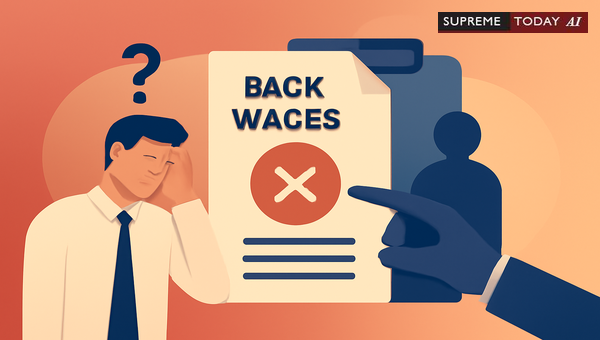
In employment disputes, particularly those involving or disciplinary actions, employees often seek along with —the wages they would have earned during the period of unemployment caused by the dispute. However, a common question arises: Is the denial of legal on the ground that the employee did not lead evidence with regard to ? This issue frequently surfaces in and in India, governed primarily by the .
This blog post examines the legal position, drawing from judicial precedents and key principles. While courts generally aim for justice, the award of is not automatic and depends on evidence, employee conduct, and case-specific facts. Note that this is general information and not specific legal advice—consult a qualified lawyer for your situation.
Courts have consistently held that entitlement to is not an absolute right but subject to the facts and circumstances of each case. Full are not awarded mechanically; instead, the adjudicating authority exercises discretion to determine what is just and fair 2009 5 Supreme 629.
A critical factor is whether the employee proves they remained unemployed or did not gain alternative employment during the dispute period. If the employee fails to substantiate non-employment, courts may deny or limit 2005 4 Supreme 31 2015 0 Supreme(SC) 1491. For instance, the respondent should not have been granted due to the lack of evidence showing that he did not work during the pendency of the matter 2015 0 Supreme(SC) 1491.
The onus typically lies on the employee to demonstrate they did not secure . Without such evidence—like affidavits, job search records, or witness statements—courts presume the employee may have mitigated losses by working elsewhere. This principle prevents and ensures fairness 2015 0 Supreme(SC) 1491.
In one case, the court modified an order to deny entirely because the employee lacked proof of non-employment 2015 0 Supreme(SC) 1491. Similarly, were reduced to 50% where the employee could not prove unemployment, factoring in their conduct 2005 4 Supreme 31 2008 0 Supreme(SC) 1321.
Courts deny or limit in several scenarios:
Judicial discretion weighs factors like service length, employment nature, and employee contributions to the dispute 2009 5 Supreme 629 2016 0 Supreme(SC) 629.
While lack of employee evidence often leads to denial, other precedents shift the burden or award partial/full wages under different facts. For example, if termination is or wholly unjustified without employee fault, denial of would be inappropriate 2023 0 Supreme(Bom) 1561. In such cases, courts consider affidavits affirming unemployment despite efforts, like surviving on relatives' support.
The dominant nature of duties determines under , with the employer bearing the burden to prove termination grounds. Here, illegal termination led to 70% , modified from full 2023 0 Supreme(Bom) 1561.
is key: Failure to comply, like flawed inquiries, can enhance to 75% 2024 0 Supreme(All) 1214. If such evidence has not been led, the Management has to suffer the consequences 2024 0 Supreme(All) 1214.
In cases of , non-payment of salaries constitutes a , entitling employees to treat the contract as terminated and claim damages
.
Moreover, if the employer fails to prove post-termination, courts direct full with 2023 0 Supreme(Telangana) 253. Petitioner is entitled for in view of the fact that 2nd respondent herein failed to adduce evidence of 2023 0 Supreme(Telangana) 253.
Denial is unsustainable if the employee was willing to work but kept out by the employer: The denial of backwages can only be in case, some fault can be with the employee in not performing his duties 2011 0 Supreme(Mad) 3237.
For daily wagers or fixed-term employees, non-compliance with still warrants with if unemployment is established 2002 0 Supreme(Guj) 269 2002 0 Supreme(Bom) 342. Courts may apportion blame, reducing to 50% in government cases 2002 0 Supreme(Bom) 342.
Courts exercise judicious discretion, considering:- Employee conduct and fault.- Nature of employment (permanent vs. casual).- Proof of unemployment or .- Employer compliance with procedures.
Full suit blatant illegal terminations; reductions (e.g., 25-75%) apply where equities balance 2005 4 Supreme 31 2023 0 Supreme(Bom) 1561.
Courts recommend judicious discretion, balancing all factors 2009 5 Supreme 629.
In summary, while employees bear the initial burden on unemployment, holistic case review ensures fairness. Stay informed on labor rights, but seek professional advice for disputes. Judicial trends emphasize evidence and equity under the Industrial Disputes Act.
References (selected):- 2005 4 Supreme 31, 2015 0 Supreme(SC) 1491, 2009 5 Supreme 629, 2023 0 Supreme(Bom) 1561, 2023 0 Supreme(Telangana) 253, 2011 0 Supreme(Mad) 3237
Word count: ~1050. This post is for informational purposes only.
#BackWages, #LaborLaw, #EmploymentRights


He had no other source of livelihood, and, therefore, claimed reinstatement with full backwages. In the affidavit of evidence also, the Respondent No. 1 affirmed that he could not secure employment despite best efforts and has been surviving on the earnings of the relatives and friends. ... If the termination appeared to be mala-fide or wholly unjustified, without there being an ounce of fault on the part of the employee, denial of backwages would pu....

If such evidence has not been led, the Management has to suffer the consequences. '' 39. ... Manager (Personnel), Hindustan Aeronautical Limited, AIR Online 2022 SC 460, to argue that the Apex Court has held that if the employee is not at fault and was kept out of work by reasons of the decision taken by the employer then the denial of fruits after being vindicated at the end of day would be ... The most important question is whether the employee is....

It is only in such a situation that the employee is entitled to regard the contract as terminated and treat himself as being dismissed. Constructive dismissal does not mean that an employee can automatically terminate the contract when his employer acts or behaves unreasonably towards him. ... From the facts and evidence before me, I found that there was an attempt to drive the Claimant out of his employment. ... In such a situation, the employee is entitled to #HL_ST....

The respondent/Corporation contended that the petitioner was not entitled for back wages since the petitioner had neither pleaded nor provided any material evidence regarding the employment status. ... (16)Hence, the writ petition is allowed and the Award of the Labour Court dated 26.02.2020 in ID.No.37/2017 insofar as it relates to denial of full backwages, is set aside. ... The Labour Court, having held that the termination was illegal, denied back wages to the petitioner on the #HL....

He however made a specific prayer for reinstatement in service with backwages, continuity of service and attendant benefits Despite his making a claim in this regard. the APSRTC did not advert to his entitlement to backwages on the ground that he was gainfully employed after he was removed from service ... warranting reduction in the payment of full backwages. ... Furthermore, whether a workman or employee of a statutory authority should be reinstate....

However, his employment as a workman since 1992 was not denied. 4. Before the Labour Court, the parties led evidence-oral and documentary. A copy of the muster roll maintained by the management was called for. ... The very idea of restoring an employee to the position which he held before dismissal or removal or termination of service implies that the employee will be put in the same position in which he would have been but for the illegal action tak....

Respondent No. 2 also in paragraph 10 of the return, has not clarified as to why the petitioner was not entitled for backwages. The return only contains evasive denial of the averments made in the body of the petition. 7. ... The very idea of restoring an employee to the position which he held before dismissal or removal or termination of service implies that the employee will be put in the same position in which he would have been but for the illega....

It will not be open for the employer to draw any inference only on the ground of earning capacity. In reaching to a conclusion with regard to gainful employment, a clinching evidence of appellant actually gainfully employed in any employment or vocation would be necessary. ... Kranti Junior Adhyapak Mahavidyalya (D.ED.) and Ors., and taking into consideration various factors relevant for decision on the issue of back wages, we are of the view that in order to do compl....
The Claimant was fortunate that the Company considered him a permanent employee and not a probationer in his fresh employment. ... In the event that backwages are to be given, such backwages shall not exceed twenty-four months' backwages from the date of dismissal based on the last-drawn salary of the person who has been dismissed without just cause or excuse;" [36] It is unchallenged evidence that the ... But, again, if we may add, these are #HL_STA....
The Claimant was fortunate that the Company considered him a permanent employee and not a probationer in his fresh employment. ... In the event that backwages are to be given, such backwages shall not exceed twenty-four months' backwages from the date of dismissal based on the last-drawn salary of the person who has been dismissed without just cause or excuse;" [36] It is unchallenged evidence that ... But, again, if we may add, these are n....

It is well settled, that the denial of backwages can only be in case, some fault can be with the employee in not performing his duties. If the employee is not permitted to perform his duties, and subsequently action of the Management is held to be bad, the denial of backwages will amount to punishment for no fault of him, which cannot be sustained in law.
( 5 ) THE learned Senior Counsel states that the employee as also the employer has not led any evidence before the Labour Court, but in the Written statement the employer has not taken any plea about denial of backwages or has not objected to grant of backwages to the employee, in any manner. He further contends that even before Industrial Court there was no such plea raised and no arguments were advanced questioning entitlement of the petitioner to grant of full backwages. He therefore contends that the learned Member of the Industrial court, has acted arbitrarily by restr....

It is also submission that the labour court has committed error in not granting full backwages on the ground of presumption of gainful employment. Therefore, the labour court has rightly appreciated these aspects and granted reinstatement with 25 % backwages of the interim period. Therefore, the labour court has committed no error while passing the award and the same does not call for any interference of this Court while exercising the powers under Article 226 and 227 of the Constitution. Therefore, Mr. Dagali has submitted that any temporary employee and / or casual employ....

The Industrial Court under revision confirmed the order of reinstatement and in my opinion rightly so. The Labour Court has denied the relief of full backwages mainly on the ground that the employee had approached the Labour Court after a lapse of more than 2 years and, therefore, the Labour Court denied full backwages to the employee. The Labour Court has in my opinion, rightly granted reinstatement with continuity of service. The Industrial Court, however, was of the opinion that the employee should be given the relief of full backwages as he was given a wrong advice by t....
Therefore, according to my opinion, the Labour Court has not committed any error. It is very well reasoned order passed on finding of fact and findings given by the Labour Court is also based on evidence. ( 13 ) CONSIDERING the above well-established law on the subject of Section 25-F of the Industrial Disputes Act, 1947, I am of the view that the Labour Court has not committed any error while coming to such a conclusion that even in case of daily wagers or an employee who was appointed on periodical basis, there is a clear finding of fact based on oral as well as documentary evidence laid b....


An indispensable Tool for Legal Professionals, Endorsed by Various High Court and Judicial Officers
Please visit our Training & Support
Center or Contact Us for assistance

Scan Me!
India’s Legal research and Law Firm App, Download now!


For Daily Legal Updates, Join us on :



 Back to top


