SupremeToday Landscape Ad

AI Overview

AI Overview...

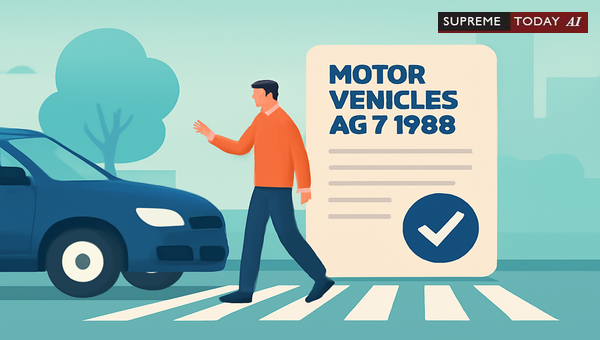
  • Pedestrians and their safety are protected under various provisions of the Motor Vehicles Act, 1988, which prohibit vehicular encroachment on footpaths and pedestrian zones. Sections 201 and 210B empower authorities to prohibit and penalize such encroachments, including illegal parking and vending on footpaths, to ensure pedestrian safety ["2025 0 Supreme(SC) 1773"].

  • The Act explicitly casts duties on drivers and vehicle riders to ensure the safety of vulnerable road users, including pedestrians. Regulation 5 of the Motor Vehicles (Driving) Regulations, 2017, mandates that drivers take special care to prevent accidents involving pedestrians, cyclists, children, the elderly, and differently-abled persons ["2023 0 Supreme(Ker) 94"].

  • Section 198A of the Motor Vehicles Act, 1988, inserted by the 2019 Amendment, imposes penalties on authorities or entities failing to maintain road safety standards, which indirectly affects pedestrian safety by ensuring proper road design, construction, and maintenance. Failure to uphold these standards can lead to penal consequences ["2022 0 Supreme(Ker) 837"], ["2022 Supreme(Online)(KER) 47349"], ["2023 Supreme(Online)(Ker) 57299"], ["2023 Supreme(Online)(KER) 25619"], ["2022 Supreme(Online)(KER) 32644"].

  • The Act also criminalizes violations such as illegal parking on footpaths, which obstructs pedestrian movement and compromises safety, especially for persons with disabilities or reduced mobility. Such violations are punishable under the relevant sections, emphasizing the statutory duty of authorities and drivers to maintain safe pedestrian pathways ["2022 0 Supreme(Ker) 837"], ["2022 Supreme(Online)(KER) 47349"], ["2022 Supreme(Online)(KER) 32644"].

  • The legal framework includes provisions for compensation and remedies for pedestrians affected by vehicular accidents, with Sections 163A and 166 providing avenues for claimants to seek damages. The courts have clarified that claims under Section 163A or 166 are applicable depending on the case specifics, with an emphasis on negligence and liability of drivers ["2025 0 Supreme(P&H) 188"], ["2023 0 Supreme(All) 1037"], ["2023 0 Supreme(Gau) 175"].

  • Certain provisions like Section 115 empower authorities to restrict vehicle use, which can be used to protect pedestrian zones, while Sections 129 and 194D, which relate to helmet use, have faced challenges regarding their constitutionality but are generally aimed at vehicle safety, indirectly impacting pedestrian safety ["2023 0 Supreme(HP) 161"], ["2025 Supreme(Online)(Tel) 76147"].

  • Overall, the Motor Vehicles Act 1988 emphasizes the safety of pedestrians through statutory duties on drivers, penalties for encroachments, and road safety regulations, with specific provisions to prevent vehicular violations on footpaths and pedestrian zones, thus safeguarding pedestrian rights and mobility ["2025 0 Supreme(SC) 1773"] ["2023 0 Supreme(Ker) 94"].

References:- ["2025 0 Supreme(SC) 1773"]- ["2023 0 Supreme(Ker) 94"]- ["2022 0 Supreme(Ker) 837"]- ["2022 Supreme(Online)(KER) 47349"]- ["2023 Supreme(Online)(Ker) 57299"]- ["2023 Supreme(Online)(KER) 25619"]- ["2022 Supreme(Online)(KER) 32644"]- ["2025 0 Supreme(P&H) 188"]- ["2023 0 Supreme(All) 1037"]- ["2023 0 Supreme(Gau) 175"]- ["2025 Supreme(Online)(Tel) 76147"]- ["2023 0 Supreme(HP) 161"]

Pedestrian Compensation and Driver Duties Under the Motor Vehicles Act 1988

MV Act 1988: Key Provisions Protecting Pedestrians on Indian Roads

Pedestrians are among the most vulnerable road users in India, facing daily risks from fast-moving vehicles, poor infrastructure, and negligent driving. With rising urban traffic, understanding legal safeguards is crucial. What are the relevant provisions of the Motor Vehicles Act, 1988 (MV Act) applicable to pedestrians? This blog explores driver duties, safety regulations, compensation mechanisms, and enforcement, drawing from key judicial interpretations.

Duty of Care Owed to Pedestrians

The MV Act places a primary duty of care on drivers to protect pedestrians. Drivers must exercise reasonable caution to avoid accidents and injuries, particularly in crowded areas or crossings. Courts have consistently emphasized this obligation, especially in pedestrian injury cases. For instance, the Act underscores that drivers bear responsibility for vulnerable users like pedestrians 2015 0 Supreme(P&H) 2183.

Provisions and regulations aim to safeguard pedestrians by imposing duties on drivers and authorities. This includes yielding right-of-way at crossings and maintaining safe speeds near footpaths 2019 0 Supreme(Ker) 380 2019 0 Supreme(Ker) 669. Failure to do so can lead to liability in negligence claims.

Restrictions and Infrastructure for Pedestrian Safety

To enhance safety, the MV Act empowers authorities to regulate traffic impacting pedestrians. Section 115 allows reasonable restrictions on traffic, such as one-way streets or barriers, adapting to public needs 2019 0 Supreme(Mad) 2782.

Central Motor Vehicles Rules mandate pedestrian facilities:- Footpaths separated from roadways.- Zebra crossings and signals.- Clear signage warning of pedestrian zones 2019 0 Supreme(Ker) 669 2019 0 Supreme(Ker) 756.

Parking on footpaths or crossings is prohibited under Rules of Road Regulations and Motor Vehicles (Driving) Regulations, with strict enforcement to prevent obstruction 2021 0 Supreme(Ker) 1136 2022 0 Supreme(Ker) 837 2019 0 Supreme(Ker) 669. Road Safety Councils play a key role in policy and infrastructure upgrades 2019 0 Supreme(Ker) 669.

Compensation and Liability in Pedestrian Accidents

Accident victims, including pedestrians, have robust remedies under the MV Act. Where driver negligence is proven, courts favor beneficial interpretations for timely compensation 1991 0 Supreme(Raj) 859 1991 0 Supreme(Raj) 590.

Key mechanisms include:- Structured claims under Section 166: Pedestrians or dependents can seek damages for injury or death.- No-fault liability: Historically under Section 140 (now omitted by Act 32 of 2019, previously Rs.50,000 for death post-1994 amendment), compensation was payable without proving fault 2024 0 Supreme(P&H) 1198.- Enhanced no-fault under Section 164: Claimants are entitled to Rs.5,00,000 for death in road accidents, irrespective of negligence. In one case, despite tribunal finding no negligence, the court awarded Rs.5,00,000 under Section 164 with 7.5% interest, applying provisions retroactively 2024 0 Supreme(P&H) 1198. The court noted, Claimants are entitled to compensation under Section 164 of the Motor Vehicles Act, 1988, irrespective of negligence, with a fixed amount of Rs.5,00,000/- for death in a road accident.

For hit-and-run accidents (Chapter VII-A), compensation is available without identifying the driver, vital for pedestrians hit by fleeing vehicles 1991 0 Supreme(Raj) 859. Non-dependent heirs may also claim under Section 166 if no dependents exist 2016 0 Supreme(Ker) 73. The court clarified, Non-dependant heirs of the deceased are entitled to claim compensation under section 166 of the Motor Vehicles Act, 1988 where there is no other dependant legal heir for claiming compensation.

Insurance liability persists even if drivers lack valid licenses, payable to third parties like pedestrians under Section 149, with recovery from owners 2020 0 Supreme(AP) 446 2020 0 Supreme(AP) 444. As held, Even if the driver of an insured vehicle does not have a valid driving licence, the insurance company is still liable to pay compensation to third parties under Section 149 read with 168 of the Motor.... However, unregistered vehicles fall outside policy protection

Kaushalendra Kumar Mishra VS The Oriental Insurance Co. Ltd.

, where Use of vehicle in violation of law itself will take it beyond protection of insurance policy.

Enforcement and Road Safety Measures

Enforcement is central to pedestrian protection. Authorities must uphold traffic rules, including speed limits and no-parking zones near pedestrian areas. Speed governors on vehicles, though challenged in some notifications, align with broader safety goals 2020 0 Supreme(Del) 821.

Driver licensing (Sections 3-5) ensures competent operation, with violations not absolving insurer liability to victims but emphasizing owner duties: The driver of a motor vehicle has a statutory duty to ensure that the driver to whom the vehicle is entrusted holds a valid and effective driving license. 2020 0 Supreme(AP) 446

Uniform rules for transport drivers, upheld under Section 88, indirectly aid identification and safety 2023 0 Supreme(Del) 4940.

Key Takeaways and Recommendations

  • Drivers and owners: Prioritize pedestrian safety through cautious driving and compliance with infrastructure rules.
  • Authorities: Implement footpaths, crossings, and signage; enforce via fines and awareness.
  • Pedestrians/Victims: In accidents, file claims promptly under MV Act sections for negligence or no-fault compensation. Gather evidence like witness statements and police reports.

Summary: The MV Act, 1988, imposes duties on drivers/authorities for pedestrian safety, mandates facilities/restrictions, offers compensation (including Rs.5L no-fault for death), and stresses enforcement 2019 0 Supreme(Ker) 380 1991 0 Supreme(Raj) 859.

This post provides general information based on the MV Act and case law. It is not legal advice. Consult a qualified lawyer for specific cases, as outcomes depend on facts and jurisdiction.

#MotorVehiclesAct #PedestrianSafety #RoadAccidentsIndia
Chat Download
Chat Print
Chat R ALL
Landmark
Strategy
Argument
Risk
Chat Voice Bottom Icon
Chat Sent Bottom Icon
SupremeToday Portrait Ad
logo-black

An indispensable Tool for Legal Professionals, Endorsed by Various High Court and Judicial Officers

Please visit our Training & Support
Center or Contact Us for assistance

qr

Scan Me!

India’s Legal research and Law Firm App, Download now!

For Daily Legal Updates, Join us on :

whatsapp-icon Back to top