


 Back
Back





2025 Supreme(Mad) 2347
IN THE HIGH COURT OF JUDICATURE AT MADRAS
N. SATHISH KUMAR, J.
R. Sudhakar - Appellant
Versus
V. Ranganathan - Respondent
A.S. No. 532 of 2025, C.M.P. No. 8146 of 2025
Decided On : 15-04-2025
Advocate Appeared:
For the Appellant : Lakshmi Narayanan
Under the Hindu Succession Act, grandchildren are not Class I legal heirs if their father is alive, affecting their entitlement to ancestral property after the grandfather's death.
Headnote:(A) Hindu Succession Act - Section 8 - Partition of property - Dispute over entitlement to share in suit property claimed to belong to grandfather - Plaintiffs sought 3/9th share, contending it was ancestral property - Court found property to be individual property of grandfather, not ancestral - Plaintiffs not classified as Class I legal heirs under applicable laws - Trial Court's dismissal of suit was upheld. (Paras 11, 13, 14)
(B) Legal heir classification - The status of heirs under the Hindu Succession Act determines entitlement to ancestral properties and shares therein; grandchildren are not considered Class I heirs when the father is alive. (Paras 14)
Facts of the case:
The plaintiffs challenged a trial court decision dismissing their partition suit regarding property acquired by their grandfather. The grandfather died intestate, leaving behind multiple heirs with conflicting claims regarding property classification.
Findings of Court:
The trial court's dismissal was based on the classification of the property, determining it as individual property rather than ancestral property, affecting the plaintiffs' claim.
Issues: The court addressed whether the property was ancestral and the rights of the plaintiffs in the context of the Hindu Succession Act.
Ratio Decidendi: The court ruled that as the property did not constitute ancestral property and the plaintiffs were not Class I legal heirs of their grandfather, the dismissal of the suit was upheld.
Result: Appeal dismissed.
| Table of Content |
|---|
| 1. claim of property partition based on ancestral ownership. (Para 1) |
| 2. ownership and inheritance rights in partition suits. (Para 3 , 4 , 5 , 6) |
| 3. judgment and appeal timeline. (Para 8 , 9 , 10) |
| 4. claim of partition based on ancestral connection. (Para 11 , 12) |
| 5. clarification on individual vs. ancestral property rights. (Para 13 , 14) |
| 6. dismissal of appeal confirms trial court ruling. (Para 15) |
JUDGMENT :
1. Challenge has been made to the decree and judgment of the trial Court dismissing the suit filed by the plaintiffs claiming partition of 3/9th share in the suit property, in the present appeal.
2. The parties are arrayed as per their own ranking before the trial Court.
3. It is the case of the plaintiffs that the suit property was acquired by one Veerabathira Naidu, the grandfather of the plaintiffs herein. He died intestate in the year 1978 leaving behind his 3 sons Krishnappa Naidu, Gopal @ Mohan Naidu and Ranganathan Naidu as his legal heirs. Krishnappa Naidu and his wife died issueless. Gopal @ Mohan died leaving behind his wife and two sons and two daughters, the defendants 3 to 6 herein, as his legal heirs.
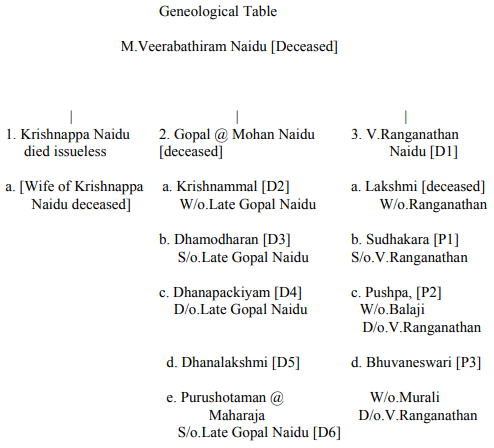
4. The plaintiffs being the grand children of Veerabathira Naidu, they are entitled to 3/9th share. They had already filed a suit in O.S.No.216 of 2011 on the file of the District Munsif's Court, Chengalpet for declaration that the settlement made by the first defendant in favour of his illegally wedded wife as null and void and the same is pending. As the plaintiffs were not given any share from the ancestral properties, they had issued a legal notice to the first defendant on 22.07.2011. Hence, the suit.
5. The first defendant denying the rights of the plaintiffs, it is his stand that the suit property is a self acquired property of the first defendant and his two brothers, viz., Krishnappa Naidu and Gopal Naidu and patta has also been issued in their name. The said Krishnappa Naidu died issue less and after his death, the first and the second defendants are entitled to a half share in the suit properties and they were allotted 'A' and 'B' schedule properties respectively.
6. In the written statement filed by the third defendant, which has been adopted by the defendants 2, 4 to 6, it is his stand that suit property has been acquired by the first defendant and his two brothers and hence, joint patta has been issued in their favour. It is his further contention that on 12.08.2011, the first defendant and the legal heirs of Gopal had partitioned the suit properties under a registered partition deed and in the said partition, 'A' schedule property has been allotted to the first defendant and 'B' schedule property has allotted to the legal heirs of the deceased Gopal.
7. On the basis of the above pleadings, the following issues have been framed by the trial Court :
1. Whether the suit properties are the ancestral properties of the plaintiffs as alleged by the plaintiffs [or] the self acquired properties of Ranganathan [D1] and Gopal as alleged by the defendants?
2. Whether the plaintiffs are entitled to get 3/9 shares in the suit property?
3. Whether the plaintiffs are entitled for permanent injunction as prayed for?
4. To what relief the plaintiffs are entitled?
8. On the side of the plaintiffs, first plaintiff examined himself as P.W.1 and Ex.A.1 to Ex.A.7 have been marked. On the side of the defendants, the first defendant examined himself as D.W.1 and the third defendant examined himself as D.W.2 and no documents have been marked on their side.
9. The trial Court, considering entire evidence, both oral and documentary, has dismissed the suit. Challenging the same, the unsuccessful plaintiffs have filed the present appeal.
10. It is relevant to note that the suit has been dismissed in the year 2015 and the appeal has now come before this Court. Be that as it may.
11. It is the main contention of the learned counsel appearing for the appellants that the suit properties belong to their grandfather. According to the












