
 Back
Back





BEFORE THE MADURAI BENCH OF MADRAS HIGH COURT
K.K. RAMAKRISHNAN, J.
State Rep. by Special Public Prosecutor - Appellant
Versus
V. Samuel Jebaraj - Respondent
Crl. Appeal (MD) No. 379 of 2019
Decided On : 04-03-2025
| Table of Content |
|---|
| 1. overview of case facts and procedural history. (Para 1 , 2) |
| 2. arguments of the appellant regarding trial errors. (Para 3) |
| 3. court analysis and evaluation of evidence. (Para 4 , 6 , 7 , 8 , 9 , 10 , 11) |
| 4. defense arguments addressing the acquittal. (Para 5) |
| 5. final order and sentencing considerations. (Para 12) |
| 6. discussion on sentencing and implications. (Para 13 , 15) |
JUDGMENT :
1. This appeal has been filed by CBI challenging the acquittal judgment passed in C.C. No.04 of 2011 on the file of learned II Additional District Judge for CBI Cases, Madurai.
2. Brief facts of the case:
The first respondent was working as a Senior Manager, Canara Bank, Nazareth Branch, Toothukudi District and the second respondent was working as a part-time employee in the said branch. P.W.2 was living within the jurisdiction of the said bank. P.W.3 is his daughter. P.W.3 submitted an Educational loan application in the said bank for pursuing nursing Course. The loan of Rs.2,50,000/- was sanctioned on 29.10.2010. At that time, the second respondent visited the house of P.W.2 and demanded a sum of Rs.12,000/- as bribe to give the cheque for the said loan amount. He demanded the said amount on behalf of A1 also. P.W.2 made a complaint to P.W.16 and after receiving the complaint, P.W.16 registered the case and trap was arranged. P.W.4 and P.W.5 official witnesses from other departments were called to act as independent official witnesses, namely as shadow witnesses. In the presence of P.W.4 and P.W.5, the the phenolphthalein test was demonstrated to P.W.2 and P.W.3. P.W.2 was specifically instructed to give the money, on the demand made by A2 and A1 and P.W.3 was directed to accompany P.W.2. After the instruction, the Entrustment Mahazar was prepared and same was marked as Ex.P7. Thereafter, they went to the respondent's office and approached A1 and A2. A2 reiterated the said demand and received the amount. Thereafter, P.W.2 and P.W.3 came out and gave the signal to the trap laying officer and the trap laying officer along with the team entered into the premises and conducted the phenolphthalein test in the hands of A2. In result, A2's hand wash turned pink in colour and thereafter, on disclosure by A2, the amount was recovered. Apart from the bribe amount, some more amount also was recovered and hence, the Police officers, CBI, registered the case and continued the investigation. Thereafter, they filed a final report against A1 and A2 and the same was taken on file in C.C.No.4 of 2011 by the learned Special Judge for CBI Cases, Madurai.
2.1. After appearance of the accused, copies of records were furnished to them under Section 207 Cr.P.C. The learned Trial Judge, on perusal of records and on hearing both sides and being satisfied that there existed a prima facie case against the accused/appellants, framed charges under Sections 120B, r/w Section 7 and 13(2) r/w 13(1)(a) and 13(1)(d) of Prevention of Corruption Act, 1988, and the same was read over and explained to them and on being questioned, the accused/respondents denied the charges and pleaded not guilty and stood for trial.
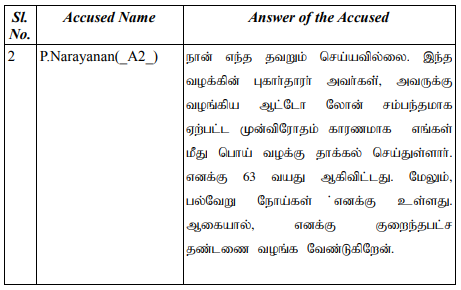
2.2. During the course of trial, the prosecution, in order to prove its case, had examined 17 witnesses as P.W.1 to P.W.17 and exhibited 37 documents as Ex.P.1 to Ex.P.37. On considering the above evidence of the prosecution, the learned trial Judge examined the accused under Section 313 Cr.P.C., by putting the incriminating circumstances available against them. The accused denied the same as false and on the side of the accused, no oral or documentary evidence was let in.
2.3. The learned trial Judge, after considering the oral and documentary evidence acquitted the accused by passing the impugned judgment. Challenging the same, the CBI filed this appeal.
3. Submission of the learned Special Public Prosecutor appearing for CBI:
3.1. The learned trial judge on the basis of inconsequential contradictions and irrelevant materials, irrelevant omissions, acquitted the
AI
The court ruled that the trial judge's acquittal was based on irrelevant contradictions, while the evidence established a clear demand and acceptance of bribe under the Prevention of Corruption Act.

The court ruled that acquittals in conspiracy cases must be based on a holistic appreciation of evidence, rejecting selective readings that undermine victims' rights and public justice.
The main legal point established in the judgment is the requirement to prove the demand for and acceptance of illegal gratification beyond reasonable doubt. The judgment emphasized that mere recovery....


Point of law: So far as the presumption under Section 20 of the PC Act is concerned, it trite that even the presumption under Section 20 of the PC Act can be drawn only if an accused person has accep....
Point of law: So far as the presumption under Section 20 of the PC Act is concerned, it trite that even the presumption under Section 20 of the PC Act can be drawn only after demand for and acceptanc....

The appellate court can reverse an acquittal if evidence of bribery and the demand for illegal payments is established beyond reasonable doubt, emphasizing that both parties bear the burden in a plea....

The demand of illegal gratification is essential to constitute an offence under the PC Act. The prosecution must establish the accusation beyond reasonable doubt, and the presumption of innocence fav....



An indispensable Tool for Legal Professionals, Endorsed by Various High Court and Judicial Officers
Please visit our Training & Support
Center or Contact Us for assistance

Scan Me!
India’s Legal research and Law Firm App, Download now!


For Daily Legal Updates, Join us on :



 Back to top


