
 Back
Back





IN THE HIGH COURT OF ALLAHABAD, LUCKNOW BENCH
SAURABH LAVANIA, J.
Consolidation Committee and Another - Petitioners
Versus
D.D.C. Faizabad and Another - Respondents
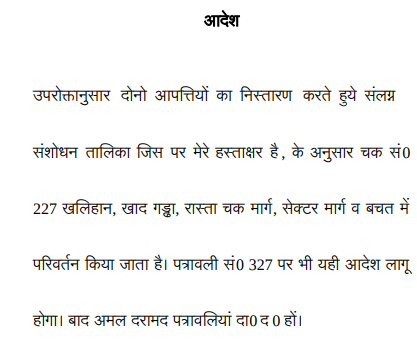
Civil Misc. Writ Petition No. 386 of 1998
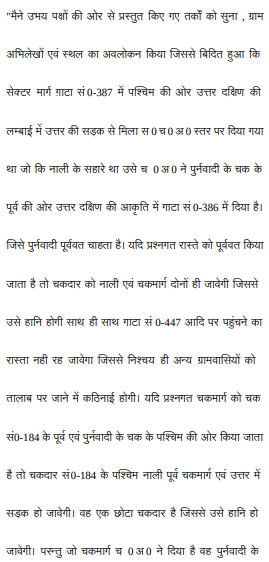
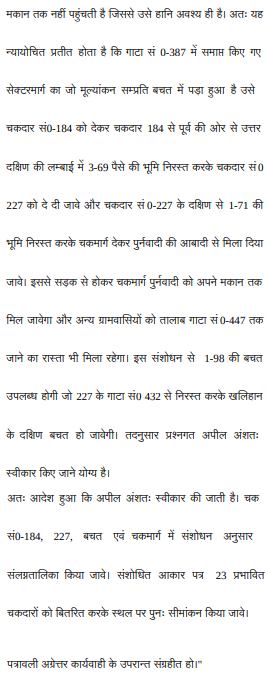
Decided On : 28-03-2024
Consolidation - U.P. Consolidation of Holdings Act, 1953 - Sections 8, 8-A, 9, 9-B, 11-A, 21, 48 - The court interpreted the provisions regarding the preparation of the Statement of Principles and the jurisdiction of consolidation authorities, affirming that failure to file objections under Section 9-B bars subsequent claims under Section 11-A.
Fact of the Case:
The petitioners challenged an order by the Deputy Director of Consolidation that interfered with prior orders of the Consolidation Officer and Settlement Officer regarding the consolidation of land holdings, specifically concerning the Statement of Principles prepared under the U.P. Consolidation of Holdings Act, 1953.
Finding of the Court:
The court found that the Deputy Director of Consolidation acted within jurisdiction, as the petitioners failed to file objections against the Statement of Principles, thus invoking the bar under Section 11-A of the Act.
Issues: Whether the bar under Section 11-A of the U.P. Consolidation of Holdings Act applies due to the petitioners' failure to file objections against the Statement of Principles prepared under Section 8-A.
Ratio Decidendi: The court held that the failure to file objections under Section 9-B results in the application of Section 11-A, which bars subsequent claims, thereby validating the Deputy Director's order.
Result: The writ petition is dismissed.
JUDGMENT :
Saurabh Lavania, J.
Heard Mr. M. A. Siddiqui, learned counsel for the petitioners and Mr. Udai Bhan Pandey, learned counsel for the private-respondent No. 2 and Mr. Hemant Kumar Pandey, learned counsel for the State.
2. By means of the present petition, the petitioners have assailed the order dated 10.7.1998 passed by respondent No. 1-Deputy Director of Consolidation, Faizabad, District-Faizabad, now Ayodhya (hereinafter referred to as the 'D.D.C.'), in Revision No. 2774 (Mata Prasad v. Buddhi Ram and others) which was filed under Section 48 of U.P. Consolidation of Holdings Act, 1953 (in short the 'Act of 1953').
3. By the impugned order dated 10.7.1998, the respondent No. 1-D.D.C. caused interference in the order dated 18.2.1998 passed by Consolidation Officer, Kuchera, Tehsil-Milkipur, District-Faizabad, now Ayodhya (hereinafter referred to as the 'C.O.) in exercise of power under Section 21(1) of the Act of 1953, as appears from Annexure 3 to the present petition, and order dated 8.6.1998, passed by Settlement Officer Consolidation, Faizabad, now Ayodhya (herein after referred to as the 'S.O.C.') in Appeal No. 955 (Mata Prasad v. Gram Sabha and others) preferred under Section 21(2) of the Act of 1953.
4. Brief facts of the case are to the effect that the petitioner No. 2/Budh Ram at the time of initiation of consolidation operation, after issuance of notification under Section 4 of the Act of 1953, was the original tenure holder of Gata No. 387, situated at Village-Parabrahamnan, Pargana-Pashchimrath, Tehsil-Milkipur, District-Faizabad, now Ayodhya.
5. For the purposes of consolidation operation in the unit/village, mentioned above, the Statement of Principles was prepared as required under Section 8-A of the Act of 1953, which is required to carry out the consolidation operation in the unit. As per Section 8 and Section 8-A and relevant rules including Rule 25-A of U.P. Consolidation of Holdings, Rules, Statements of Principles shall contain the details of area to be earmarked for extension of Abadi including area for Abadi site for Harijans and landless persons and other public purposes, the basis on which tenure-holders will contribute land for extension of Abadi and other public purposes etc., the standard plot for each unit. Thereafter notice under Section 9 is to be issued containing extract from the records and statements prepared under Sections 8 and 8-A of the Act of 1953, inviting objections. Sections 9-A to 9-C provide for filing of objections and appeal. Section 11-A of the Act creates a bar to objections in respect of claims to land, partition of joint holdings and valuation of plots, trees and other improvements which has been raised under Section 9 or ought to have been raised under that section but has not been raised at any subsequent stage of consolidation proceedings.
6. Admittedly to the Statement of Principles prepared, no objection was filed by the petitioner No. 2/Budh Ram or by the Gaon Sabha or by petitioner No. 1/Consolidation Committee required under Section 9-B of the Act of 1953.
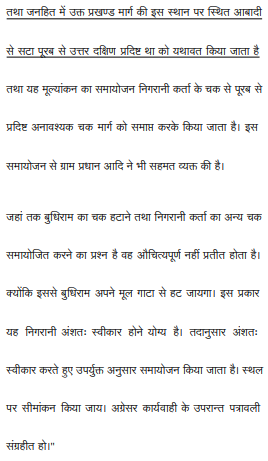
7. During the consolidation proceedings, the respondent No. 2-Mata Prasad represented by Mr. Pandey preferred an objection with regard to allotment of chaks before the C.O. In the proceedings instituted by the respondent No. 2-Mata Prasad before the C.O., the petitioner No. 2 and others prayed for removing the Sector road indicated in the Statement of Principles by preferring an objection and this prayer was allowed by the C.O. vide order dated 18.2.1998. The operative portion of the order dated 18.2.1998 is extracted here-in-under :
8. Being aggrieved, respondent No. 2-Mata Prasad instituted an Appeal No. 955 and the S.O.C. vide order dated 8.6.1998 partly allowed the Appeal. Relevant portion of the order dated 8.6.1998 is extracted here-in-under :
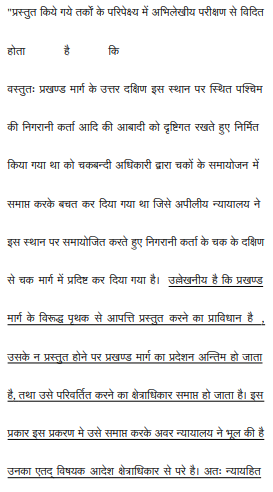
9. Challenging the order(s) dated 18.2.1998 and 8.6.1998 passed by C.O. and S.O.C., respectively, the respondent No. 2-Mata Prasad filed the Revision No. 2724 and after co
AI
Failure to file objections against the Statement of Principles under Section 9-B invokes the bar of Section 11-A, preventing subsequent claims in consolidation proceedings.

A party must file timely objections under the Uttar Pradesh Consolidation of Holdings Act, or claims related to land within the consolidation scheme are deemed invalid, and previous orders cannot be ....
The U.P. Consolidation of Holdings Act allows authorities to adjudicate on land rights even when a wrong provision is cited, as long as they possess the necessary jurisdiction.
Legal proceedings initiated after the issuance of consolidation notifications are invalid under the Uttar Pradesh Consolidation of Holdings Act, 1953, as outlined in Section 5(2), and proper filing o....
Consolidation authorities must adhere to statutory provisions when allotting chak(s) and provide justifications for deviations to ensure equitable treatment of tenure holders.
Consolidation authorities must adhere to statutory provisions when allotting chaks, ensuring tenure holders receive compact areas near their largest holdings.
The Deputy Director of Consolidation cannot review its orders on merits, but the High Court may refrain from interference if substantial justice is achieved.
The consolidation authorities must allot compact areas reflecting legal rights under Section 19(1)(e), ensuring valid reasons for any deviations from the standard principles of allotment.
Consolidation authorities must adhere to statutory provisions in allotting chaks, ensuring tenure holders receive compact areas where they hold the largest part of their holdings.



An indispensable Tool for Legal Professionals, Endorsed by Various High Court and Judicial Officers
Please visit our Training & Support
Center or Contact Us for assistance

Scan Me!
India’s Legal research and Law Firm App, Download now!


For Daily Legal Updates, Join us on :



 Back to top


