Searching Case Laws & Precedent on Legal Query.....!
Analysing the retrieved Case Laws
Scanned Judgements…!



Searching Case Laws & Precedent on Legal Query.....!
Analysing the retrieved Case Laws
Scanned Judgements…!
Eligible Family Members for Compassionate Appointment - The primary categories include wife/husband, sons, unmarried or widowed daughters, and in certain cases, dependents such as brothers, sisters, or widowed mothers if the deceased was unmarried. The purpose is to support families in distress due to the death of the breadwinner. Over time, the scope has been expanded to include legally adopted children and other dependents ["G.O.Ms.No.687"], 1977; G.O.Ms.No.687.O.Ms.No.612, ["1991"].
Dependents of Deceased Government Servant - The scheme generally favors immediate family members like sons and unmarried daughters. Married daughters typically cease to be eligible once they marry, as their dependency status changes. The appointment is meant to assist families in indigent circumstances, not to provide a right irrespective of need ["G.O.Ms.No.687"], 1977; 2025 0 Supreme(Telangana) 632.
Time Limit for Application - Applications for compassionate appointment must generally be submitted within three years of the death of the government servant. Late applications, sometimes made years after the death, are often rejected unless exceptional circumstances are proved ["2023 0 Supreme(Mad) 2511"], 1995 guidelines.
Requirement of Dependency and Need - The family must demonstrate dependency on the deceased at the time of death and that they are in indigent circumstances. Merely being a dependent at the time of death is not sufficient; proof of financial need and dependency is necessary ["2025 0 Supreme(AP) 151"], ["2024 0 Supreme(AP) 1447"].
Legal and Constitutional Considerations - Discrimination claims have been raised if dependents are denied based on marital status or other grounds, asserting that the object of compassionate appointment is social security support, which should be uniformly available to eligible dependents ["2024 0 Supreme(AP) 1447"], ["
Neelam Mishra VS State of U. P. - Allahabad
"].Case Law and Judicial Clarifications - Courts have clarified that compassionate appointment is not a vested right and can be denied if applications are belated or if the family’s financial condition does not warrant support. The timing of application and the dependency status at the time of death are crucial factors. Even long-delayed requests are subject to reconsideration if justified ["2024 0 Supreme(All) 168"], ["2023 0 Supreme(Telangana) 605"].
Analysis and Conclusion:The main points indicate that a widow (wife) of a deceased government servant is generally eligible for compassionate appointment, especially if the family is in indigent circumstances and the application is made within the prescribed period. The eligibility of children, including sons and unmarried daughters, depends on dependency, marital status, and timing of application. Married daughters typically lose eligibility once married, unless specific provisions or exceptional circumstances apply. The purpose of compassionate appointment remains to support families in distress, and delays or lack of dependency proof can lead to rejection. Judicial rulings emphasize that compassionate appointment is a benefit, not a right, and must be granted based on dependency, need, and timely application.
References:- G.O.Ms.No.687.O.Ms.No.687 (1977) and G.O.Ms.No.687.O.Ms.No.612 (1991): Definitions and scope of family and eligible dependents.- 2023 0 Supreme(Mad) 2511, 2025 0 Supreme(Mad) 4637, 2024 0 Supreme(All) 168: Court judgments emphasizing dependency, timely application, and the non-vested nature of the right.- 2025 0 Supreme(AP) 151, 2024 0 Supreme(AP) 1447, 2025 0 Supreme(Telangana) 632, 2023 0 Supreme(Telangana) 605: Judicial and administrative guidelines on eligibility, dependency, and application timing.
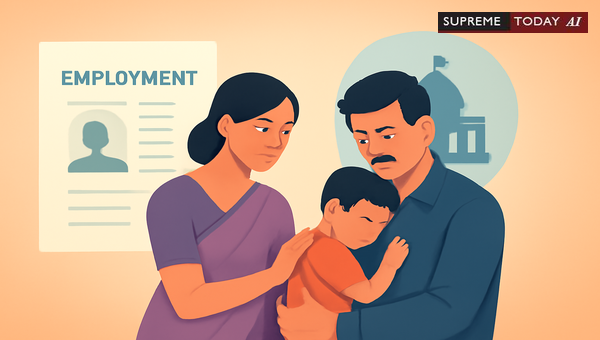
Losing a breadwinner in the family can plunge dependents into financial distress, especially when the deceased was a government servant. Families often turn to schemes for immediate relief. But what if both husband and wife were government employees? Can the son claim a compassionate job after the husband's death?
This is a common query: Husband and Wife are Government Servants and after Death of Husband the Claim of of Son. In this post, we explore the legal landscape, key rules, court interpretations, and exceptions to help you understand your options.
Note: This is general information based on precedents and rules. It is not legal advice. Consult a lawyer for your specific case.
is a benevolent scheme providing government jobs to dependents of deceased employees facing sudden hardship. It is an exception to merit-based recruitment, aimed at alleviating immediate economic distress. However, it is not a but governed strictly by rules and schemes in force. 2024 0 Supreme(All) 218 2022 0 Supreme(All) 1488
Key objectives include:- Supporting families without a breadwinner.- Preventing vagrancy and destitution.- Limited to eligible dependents under specific conditions.
The claim for the son's is typically barred if the surviving spouse (wife) was already in government service at the time of the husband's death. Courts have consistently ruled that when the spouse is employed, the family does not face the intended , disqualifying other dependents like children. 2024 0 Supreme(All) 218
As per relevant rules, such as , is restricted to cases where the spouse is not in government service at the death. The rationale: The employed spouse's income sustains the family. 2024 0 Supreme(All) 218
If the surviving spouse was employed in government service at the time of the deceased employee’s death, dependent children are typically not eligible for . 2024 0 Supreme(All) 218
Compassionate schemes across states (e.g., Uttar Pradesh, Tamil Nadu) emphasize and . They are humanitarian measures, not entitlements. Core principles include: 2024 0 Supreme(All) 218 2022 0 Supreme(All) 1488
In Uttar Pradesh and similar schemes, explicit bars exist:- Surviving spouse in service → No claim for children. 2024 0 Supreme(All) 218
Indian courts uphold these limits:
The employment of the spouse during the lifetime of the deceased generally disqualifies other dependents from claiming . 2024 0 Supreme(All) 218
and precedents reinforce: Schemes prevent misuse when family is secure. 2022 0 Supreme(All) 1488
In the scenario—husband (deceased govt servant) and wife (also govt servant)—the son's claim is not sustainable. The wife's ongoing service means no sudden penury. Rules explicitly bar such claims to avoid multiple appointments per family. 2024 0 Supreme(All) 218
This applies across central/state schemes unless specified otherwise.
While the general rule holds, limited exceptions may apply:
The petitioner's claim for could not be denied due to the created by the sudden demise... . 2023 0 Supreme(Mad) 2939G.O.Ms.No.687.
Courts have expanded eligibility in other contexts, offering context:
Maj. (Retd. ) Nidhi Singh VS Animesh Singh
2022 0 Supreme(UK) 205 2021 0 Supreme(MP) 445After the death of government servant, it is open to the spouse to decide and opt whether his/her son or daughter is best suited for .
Maj. (Retd. ) Nidhi Singh VS Animesh Singh
Equality for daughters: Marital status doesn't bar claims; violates Constitution. 2024 0 Supreme(AP) 380 2020 0 Supreme(MP) 1060
Priority in circulars: For married deceased, widowed spouse first, then son/adopted son; brothers last. 2022 0 Supreme(Chh) 8
These highlight evolving equity but reinforce spouse employment bar for children. 2024 0 Supreme(All) 218
For families navigating this:
is not a right and depends on the rules in force. 2022 0 Supreme(All) 1488
serves families in genuine distress, not secure ones. When both spouses are govt servants, the son's claim is generally barred, prioritizing rule-bound fairness. Always verify specific rules and consult professionals.
Key Takeaways:- Spouse in service → Children typically ineligible. 2024 0 Supreme(All) 218- Not a right; hardship-based.- Exceptions rare; equality advancing for daughters.
Stay informed—rules evolve. For personalized guidance, contact a legal expert.
References:1. 2024 0 Supreme(All) 218: Core on spouse employment bar.2. 2022 0 Supreme(All) 1488: No right, rule-dependent.3. Other cases: 2023 0 Supreme(Mad) 2939G.O.Ms.No.687. , 2024 0 Supreme(AP) 380,
Maj. (Retd. ) Nidhi Singh VS Animesh Singh
, 2022 0 Supreme(UK) 205, 2022 0 Supreme(Chh) 8, 2021 0 Supreme(MP) 445, 2020 0 Supreme(MP) 1060. #CompassionateAppointment, #GovtServantDeath, #LegalRightsIndia


G.O.Ms.No.687, dated 03.10.1977, states that compassionate appointments can only be provided to the wife, son, or unmarried daughter of the deceased government servant. 5. ... The definition of 'family' includes wife or husband, sons, unmarried and widowed daughters, and if the deceased was an unmarried Government servant, the brother, unmarried sister and widowed mother dependant on the deceased Government #HL_STA....

It is relevant to note that as per the scheme of the Government, Son/Unmarried Daughter/Husband/legally adopted son/legally unmarried adopted daughter/widowed daughter/ divorced daughter/ deserted daughter of the deceased Government servant are entitled for the compassionate appointment. ... eligibility may be given for appointment, provided application for compassionate ground appointment submitt....

It is an admitted fact that the husband of the petitioner died on 11/6/2016. The wife of the deceased made a representation for compassionate appointment to his elder son on 30/4/2018. After attaining majority, the petitioner again made a representation on 1/8/2022 for compassionate appointment. ... In similar circumstances, where the elder son of the Government servant died and an application was made after six ye....
of death of the Government Servant. ... of death of the government servant, has been considered and appointment has also been granted. ... appointment over the death of her husband right from the year 1999. ... Per contra, Mr.A.M.Ayyathurai, learned Government Advocate submitted that as per G.O.Ms.No.120 Labour and Employment Department, dated 26.06.1995, an application for appointment#H....

The definition of ‘family’ includes wife or husband; sons; unmarried and widowed daughters; and if the deceased was an unmarried government servant, the brother, unmarried sister and widowed mother dependant on the deceased government servant. ... In view thereof, I do not find that the competent authority has committed any error of law in rejecting the claim of the petitioner for her appointment on compassionate ground after #HL_ST....

As a consequence of the condition, a married daughter ceases to fall within the family of a deceased government servant to seek compassionate appointment. 18. ... In consequence, we direct that the claim of the petitioners for compassionate appointment shall be reconsidered. ... In the above case, the Uttar Pradesh Recruitment of Dependents of Government Servants Dying-in-Harness Rules, 1974 have been framed under the proviso to Article 309 of the Co....

There are situations where a son of the deceased Government servant may not be in need of compassionate appointment because the economic and financial position of the family of the deceased are not such as to require the grant of compassionate appointment on a preferential basis. ... The object of compassionate appointment is a social security measure to support the family of the deceased Government serva....

In the present case the deceased employee left behind his wife, who is the petitioner herein. The claim of the petitioner for compassionate appointment of her daughter was rejected. Now after demise of her husband, it is the responsibility cast upon the petitioner to take care of her children. ... There are situations where a son of the deceased government servant may not be in need of compassionate appointment bec....
This Court further clarified in the said case that compassionate appointment is not a vested right which can be exercised at any time after the death of a government servant. ... Belated requests for Compassionate Appointment (a) Ministries/Departments can consider requests for compassionate appointment even where the death or retirement on medical grounds of a Government servant....

Further, the purpose of providing the compassionate appointment to a wife/son /daughter or a near relative of the deceased Government servant is to render assistance to the family, which is found in indigent circumstances. ... Compassionate appointment is not a vested right which can be exercised at any time after the death of a Government servant. ... Learned counsel for the petitioner would subm....

After the death of government servant, it is open to the spouse to decide and opt whether his/her son or daughter is best suited for compassionate appointment and take responsibilities towards family which were being discharged by the deceased government servant earlier.” As per the policy of compassionate appointment, State has already decided to consider claims of the married daughters (Clause 2.4) for compassionate appointment but such consideration was confined to such daughters who have no brothers.

As per the policy of compassionate appointment, State has already decided to consider claims of the married daughters (Clause 2.4) for compassionate appointment but such consideration was confined to such daughters who have no brothers. After the death of government servant, it is open to the spouse to decide and opt whether his/her son or daughter is best suited for compassionate appointment and take responsibilities towards family which were being discharged by the deceased government servant earlier.”

7. A careful perusal of the aforesaid clauses would show that on death of a married deceased Government servant, his/her widowed husband/wife would be entitled for compassionate appointment and in their absence, the son/adopted son would be entitled. Clause 6 of the Circular clearly shows that in case the Government Servant is unmarried, his/her brother would be entitled for compassionate appointment.

The Constitution Bench of Supreme Court in Budhan Choudhry (supra), held that substantive law, procedural law or even an action can be interfered with if it does not pass the “litmus test” laid down in the said case. After the death of Government servant, it is open to the spouse to decide and opt whether his/her son or daughter is best suited for compassionate appointment and take responsibilities towards family which were being discharged by the deceased Government servant earlier. The offending clause which restricts such consideration only for such married daughter is s....

The Constitution Bench of Supreme Court in Budhan Choudhry(supra) held that substantive law, procedural law or even an action can be interfered with if it does not pass the "litmus test"‚laid down in the said case. The offending clause which restricts such consideration only for such married daughter is subject matter of consideration and examination. After the death of Government servant, it is open to the spouse to decide and opt whether his/her son or daughter is best suited for compassionate appointment and take responsibilities towards family which were being discharged by th....


An indispensable Tool for Legal Professionals, Endorsed by Various High Court and Judicial Officers
Please visit our Training & Support
Center or Contact Us for assistance

Scan Me!
India’s Legal research and Law Firm App, Download now!


For Daily Legal Updates, Join us on :



 Back to top


