


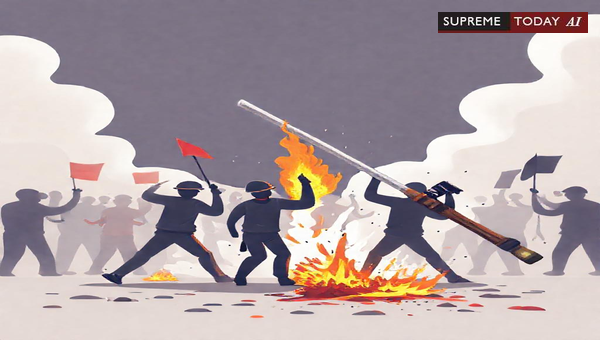
Whether a Lakdi or Stick Counts as a in a IPC Case
A recurring question in prosecutions across Indian trial courts is whether an ordinary piece of wood — a lakdi, lathi, or stick — can be treated as a for an offence under of the . The answer matters because the difference between a conviction under (simple ) and ( armed with a ) can significantly affect the sentence an accused faces.
The Statutory Framework of IPC
punishes a person who is guilty of while armed with a or with anything which, used as a , is 2024 6 Supreme 682. Three ingredients therefore come together:
- The accused must be a member of an ;
- The assembly, or one of its members, must have used force or violence, making it guilty of under ;
- The specific accused must have been armed with a , or with any object which, used as a , is 2023 0 Supreme(Chh) 185.
Possession of the is treated as an of the offence, and only the person actually armed can be convicted under this provision 2017 0 Supreme(Ori) 1328.
The Test Courts Apply to a Lakdi
The definition of a is not confined to firearms, swords, or knives. Any instrument can qualify if, in the circumstances of the case, it was used or carried as a . In , the Supreme Court held that a knife is a , and in the observed that the words are of common use and need no special interpretation — a knife can cut, pierce, and kill irrespective of its size 2025 Supreme(Online)(HP) 7446.
But a stick stands on different footing. Indian courts have repeatedly drawn a distinction between weapons that are inherently dangerous and ordinary objects whose character depends entirely on how they were used. The key inquiry is whether the lakdi was:
- Carried or used as a , rather than lying at hand for some innocent purpose;
- Capable of causing death in the manner it was actually deployed;
- Supported by evidence of — for example, blows aimed at the head or vital parts.
Do Not Automatically Qualify
The clearest guidance on sticks comes from cases involving rural altercations. Courts have held that lathis, tangis, and even bows and arrows, when carried as common in an ordinary field setting, do not by themselves bring a case within 2026 0 Supreme(Ori) 544. The same reasoning applies to a plain lakdi: without proof that it was wielded as a , the charge typically fails.
By contrast, where miscreants arrive armed with weapons specifically to trespass and beat a person to death, courts have treated the assembled weapons as deadly and upheld liability under 2023 0 Supreme(All) 1421. The object's ordinary character matters less than the manner of its use and the purpose of the assembly.
Courts have also rejected objects that seem innocuous on their face — in one appellate ruling, an umbrella used in an assault was held not to be a , and the ingredients of were held unmade 2023 0 Supreme(Chh) 84.
and the Burden of Proof
A critical feature of is that liability is individual, not constructive. Prosecution must establish which specific accused was armed with the weapon. Where the evidence fails to show which respondent carried a , acquittal under Sections 144 and 148 has been confirmed, the courts noting that liability under these sections is individual and not constructive 1996 0 Supreme(Bom) 426. Similarly, where the final report attributed no weapon to particular petitioners, the charge could not stand 2026 0 Supreme(Mad) 1238. In another matter, since the FIR and evidence showed only some accused carried deadly weapons, conviction of all appellants under was found unsustainable and was altered
Damaji S/o Ghuranlal vs State of Madhya Pradesh
. The same principle led to acquittal of four accused who, on the evidence, carried no , while only two who did remained liable 2019 0 Supreme(Chh) 266.There is, however, a divergent strand of authority: one decision has held that a member of an can be guilty under read with if any member of the assembly uses force in prosecution of the , even if that particular member is not personally armed 1926 0 Supreme(Mad) 141. The prevailing and safer view for trial practice remains that specific arming must be proved against the individual 2019 0 Supreme(Ker) 686.
and — The Alternative Routes
If the lakdi does not qualify as a , the prosecution is not necessarily without remedy:
- covers simple and is the appropriate charge where no is proved 2023 0 Supreme(All) 1421;
- creates for every member of an for offences committed in prosecution of the , though it does not create a separate offence 2023 0 Supreme(All) 1421.
Thus an unarmed member of an assembly may still face conviction under Sections 147 or 149 — and in appropriate cases even for substantive offences with the aid of — but a conviction demands proof that he himself was armed.
Practical Takeaways for Prosecution and Defence
- Prosecution should adduce specific, witness-backed evidence that the accused carried or used the lakdi as a — general or omnibus allegations are insufficient 2021 0 Supreme(Mad) 3000.
- The nature of injuries inflicted often helps: head injuries or fractures from stick blows strengthen the deadly-weapon inference; simple injuries weaken it.
- The defence should emphasise the ordinary, agricultural or incidental character of the stick, and the absence of specific attribution of the weapon to the accused.
- Courts examine the statutory text closely: under , whoever is guilty of , being armed with a or with anything which used as a , is is punishable 2022 4 Supreme 168.
Conclusion
A lakdi is not automatically a under IPC. The determination is fact-specific: courts look to how the stick was carried, the manner of its use, the injuries caused, and whether can be inferred. Where the stick was merely an agricultural implement or was not specifically attributed to the accused, generally fails, and the case may fall under or instead. Because outcomes vary with the evidence in each case, anyone facing or prosecuting such charges should treat this as general information and seek case-specific counsel for their particular circumstances.
#Section148IPC #DeadlyWeapon #Rioting #IndianPenalCode #CriminalLaw









